UXDE dot Net Wordpress Themes

Posts Tagged: "Pressure Sensors"

Pressure Transducer

in Transducers / 3 Comments

A pressure transducer is used to convert a certain value of pressure into its corresponding mechanical or electrical output. Measurement if pressure is of considerable importance in process industries.

Types

 The types of pressure sensors are differentiated according to the amount of differential pressure they are able to measure.
For low differential pressure measurement Liquid Column Manometers are used. Elastic type pressure gauges are also used for pressure measurement up to 700 MPa. Some of the common elastic/mechanical types are:

Other Types:

 Before going into further details regarding pressure measurement, it is important to know the different terms related to pressure.

 Basic Terms Related To Pressure Measurement

  • Pressure

Pressure is known to be the force that is exerted due to the weights of different gases and liquids. Some common examples are atmospheric pressure and the pressure implied by liquids inside the walls and underside of a container.

Pressure can be measured as the force exerted over a certain area.

Pressure = Force/Area

Pressure is not an independent variable as it is derived from force and area and it is not ideal as it depends on other factors like elevation, fluid density, temperature, flow velocity, and so on.

In instrumentation analysis, pressure is commonly expressed in pounds per square inch (psi). It can also be expressed in pounds per square feet (psf) and Pascals (Pa). Pascal is the SI unit if pressure. In many cases, pressure is expressed in terms of atmosphere which is the height of the barometric column at zero degrees Celsius, being equal to 76 cm of mercury or equivalent to 14.696 pounds per square inch absolute, 1 kg/cm2. Most of the pressures range from a little below atmosphere to hundreds of atmospheres.

  • Density is the mass per unit vlume of the material. It can be expressed as kilogram per cubic meter. (kg/m3).
  • Specific Weight is the weight per unit volume of the material. It can be expressed as Newon per cubic meter (N/m3).
  • Specific Gravity is basically a non-dimensional value as it is the ratio of two measurements in the same unit. It can be the ratio between the density of a material and the density of water or even the ratio between the specific weight of a material to the specific weight of water.
  • Static Pressure is the fluid or gas pressure that does not move.
  • Dynamic Pressure is the gas or fluid pressure that is obtained when it impacts with a surface or an object due to its motion or flow.
  • Impact Pressure is the total pressure or the addition of both the static and dynamic pressures.
  • Atmospheric Pressure is the surface pressure of earth and is available due to the weight if the gases in the earth’s atmosphere.
  • Another important aspect of pressure measurement is the measurement of very low pressure or what is known as vacuum. With the advancement of scientific research and industrial application of the results, pressure is as low as 10-6 mm of mercury is often required to be measured in some systems. Measurement of pressure, therefore, consists of two parts – that of pressure and vacuum. The force exerted by the fluid per unit area of the wall of the container is called the absolute pressure, whereas the gauge pressure is the difference between the absolute and local atmospheric pressure, and when gauge pressure is negative, it is known as vacuum.

Basic methods of pressure measurement are same as those of force measurement. For high vacuum, however, some special techniques are necessary. Primary sensors are mostly, mechanical which through secondary sensing means provide electrical outputs. Manometers and elastic element sensors are used as primary pressure sensors while secondary sensing, often called transducing here, involves resistive, inductive and capacitive changes for deriving electrical outputs.

You may also like:

 Pressure Instrument Selection

Selection of pressure instrument for a particular application must be done carefully, taking into consideration various aspects such as process conditions, turn down requirements, accuracy, installation requirements, and so on.

 While selecting a pressure instrument for a particular application, the process data such as fluid phase, pressure, temperature, density and viscosity must be correctly defined for all operating conditions including start-up, emergency operations and design conditions.

 Another important parameter for selection is the turn down requirements, based on which we can select the pressure instrument to suit the maximum and minimum conditions within its specified accuracy limits.

 In addition to the above, the installation requirements of the selected pressure instrument shall be carefully addressed taking in to account visibility, accessibility, because these requirements may affect the piping layouts.

Piston Type Pressure Transducer

As shown in the figure below, the input pressure is given to the piston. This moves the piston accordingly and causes the spring to be compressed. The piston position will be directly proportional to the amount of input pressure exerted. A meter is placed outside the piston and spring arrangement, which indicates the amount of pressure exerted. As the device has the ability to withstand shock, sudden pressure changes, and vibrations, it is commonly used in hydraulic applications. Mostly, the output of the piston and spring arrangement is given to a secondary device to convert movement into an electrical signal.

Piston Type Pressure Transducer
                Piston Type Pressure Transducer

Bell Gauge

The bell gauge is a type of pressure transducer that measures differential pressure between 0.06 Pa and 4 KPa. The static pressure may be as high as 4 to 6 MPa. The schematic diagram of a single element bell gauge is shown below.

Bell Gauge

Bell Gauge

The movement of the bell is taken out by link and lever mechanism or by some electrical methods. When the bell moves maximum up or down it closes the inlets of pressure p2 or p1, whereby protection to overrange and reversal of pressure are afforded. The diagram of a two element bell differential gauge or balance is also shown above. The two identical bells are suspended from the two knife edges of a balance beam. The differential weight is balanced statically by the movement of the counter weight w.
Strain Gauge

in Transducers / 5 Comments

Strain Gauge is a passive transducer that converts a mechanical elongation or displacement produced due to a force into its corresponding change in resistance R, inductance L, or capacitance C. A strain gauge is basically used to measure the strain in a work piece. If a metal piece is subjected to a tensile stress, the metal length will increase and thus will increase the electrical resistance of the material. Similarly, if the metal is subjected to compressive stress, the length will decrease, but the breadth will increase. This will also change the electrical resistance of the conductor. If both these stresses are limited within its elastic limit (the maximum limit beyond which the body fails to regain its elasticity), the metal conductor can be used to measure the amount of force given to produce the stress, through its change in resistance.

Strain Gauge Transducer

The device finds its wide application as a strain gauge transducer/sensor as it is very accurate in measuring the change in displacement occurred and converting it into its corresponding value of resistance, inductance or capacitance. It must be noted that the metal conductor which is subjected to an unknown force should be of finite length.

Types

Strain gauge transducers are broadly classified into two. They are

  1. Electrical Resistance Type Strain Gauge

In an electrical resistance strain gauge, the device consists of a thin wire placed on a flexible paper tissue and is attached to a variety of materials to measure the strain of the material. In application, the strain gauge will be attached to a structural member with the help of special cement. The gauge position will be in such a manner that the gauge wires are aligned across the direction of the strain to be measured. The wire used for the purpose will have a diameter between 0.009 to 0.0025 centimeters. When a force is applied on the wire, there occurs a strain (consider tensile, within the elastic limit) that increases the length and decreases its area. Thus, the resistance of the wire changes. This change in resistance is proportional to the strain and is measured using a Wheatstone bridge.

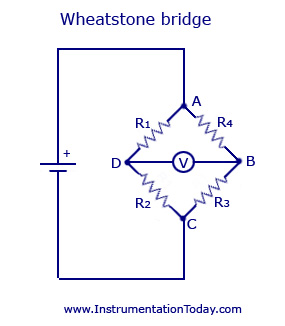
A simple Wheatstone bridge circuit is shown in the figure below. It can be set in three different ways such as – full bridge, half bridge or quarter bridge. A full bridge will have all four of its gauges active. The half bridge will have two of its gauges active and thus uses two precise value resistors. The quarter bridge will have only one gauge and the rest of the resistors will be precise in value.

Wheatstone Bridge
                Wheatstone Bridge

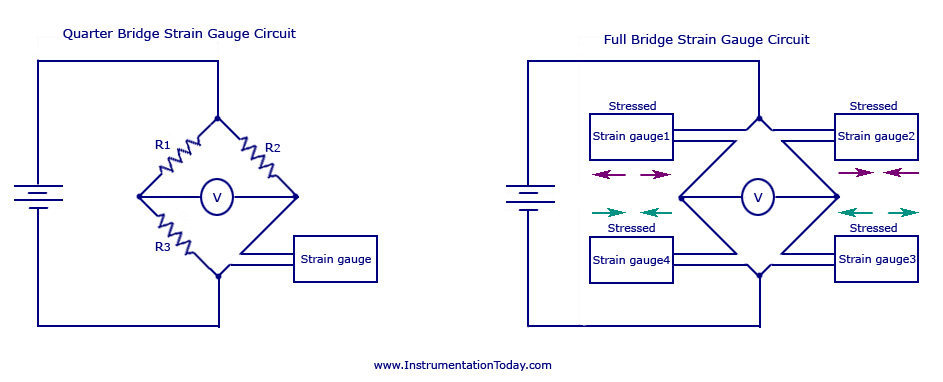
A full bridge circuit is used in applications where complimentary pair of strain gauges is to be bounded to the test specimen. In practice, a half bridge and full bridge circuit has more sensitivity than the quarter bridge circuit. But since, the bonding is difficult, a quarter bridge circuits are mostly used for strain gauge measurements. A full bridge circuit is said to be more linear than other circuits.

An external supply is given to the bridge as shown in the diagram. Initially, when there is no application of strain, the output measurement will be zero. Thus, the bridge is said to be balanced. With the application of a stress to the device, the bridge will become unbalanced and produces an output voltage that is proportional to the input stress.

The application of a full bridge and quarter bridge strain gauge circuit is shown in the figure below.

Quarter And Full Bridge Strain Gauge Circuit
                                 Quarter And Full Bridge Strain Gauge Circuit

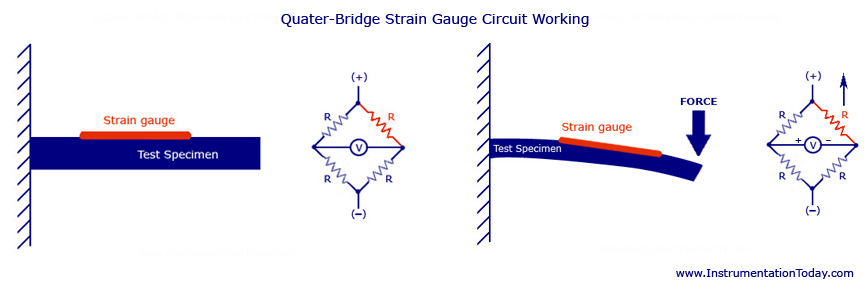
A quarter bridge output corresponding to the application of a force is shown below. Initially, the circuit will be balanced without the application of any force. When a downward force is applied, the length of the strain gauge increases and thus a change in resistance occurs. Thus an output is produced in the bridge corresponding to the strain.

Quarter Bridge Strain Gauge Circuit-Working
                                  Quarter Bridge Strain Gauge Circuit-Working

The wire strain gauge can be further divided into two. They are bonded and unbonded strain gauge.

As shown in the figure below, an unbounded strain gauge has a resistance wire stretched between two frames. The rigid pins of the two frames are insulated. When the wire is stretched due to an applied force, there occurs a relative motion between the two frames and thus a strain is produced, causing a change in resistance value. This change of resistance value will be equal to the strain input.

Unbonded Strain Gauge
                            Unbonded Strain Gauge

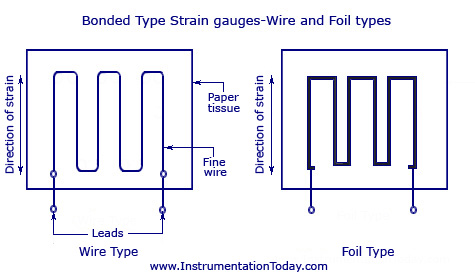
A bonded strain gauge will be either a wire type or a foil type as shown in the figure below. It is connected to a paper or a thick plastic film support. The measuring leads are soldered or welded to the gauge wire. The bonded strain gauge with the paper backing is connected to the elastic member whose strain is to be measured.

Bonded Type Strain Gauges
                                        Bonded Type Strain Gauges

According to the strain to be measured, the gauges can be classified as the following.

  • Uniaxial/Wire Strain Gauge

The figure of such a strain gauge is shown above. It mostly uses long and narrow sensing elements so as to maximize the length of the strain sensing material in the desired direction. Gauge length is chosen according to the strain to be calculated.

Gauge Configurations

Gauge Configurations

  • Biaxial Strain Gauges

When the measurement of strain is to be done in two directions (mostly at right angles), this method is used. The basic structure for this is the two element 90 planar rosette or the 90 planar shear/stacked foil rosette. The gauges are wired in a Wheatstone bridge circuit to provide maximum output. For stress analysis, the axial and transfers elements have different resistances which can be selected that the combined output is proportional to the stress while the output of the axial element alone is proportional to the strain. The figure is given below.

  • Three Element Rosettes

It is divided into two types – three element 60delta rosette strain gauge and three element 45planar rectangular rosette. They are used in applications where both the magnitude and direction of the applied strains are to be found out. Both the figures are shown below. The 60 rosette is used when the direction of the principal strain is unknown. The 45 rosette is used to determine a high angular resolution, and when the principal strains are known.

    2.   Semiconductor Strain Gauge

This is the most commonly used strain gauge as a sensor, although the bonded type may also be used in stress analysis purposes. The bonded type is usually made in wafers of about 0.02 centimeters in thickness with length and resistance values nearly equal to the wire gauge. It uses either germanium or silicon base materials to be made available in both n-type or p-type. The p-type gauges have a positive gauge factor while the n-type gauges have a negative gauge factor. Temperature dependence of gauge factor is governed by the resistivity of the material. The large value of the gauge factor in semiconductor gauges is attributed to the piezoresistance effect in such materials.

Variable Inductance Type Strain Gauge

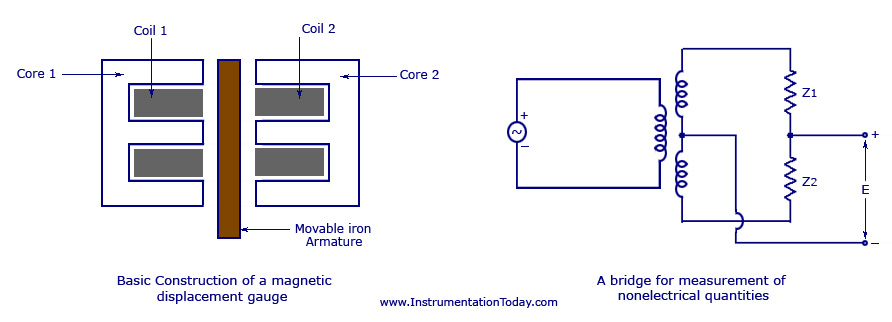
The basic arrangement of a variable inductance strain gauge is shown below. This type of strain gauge is very sensitive and can be used to measure small changes in length – as small as 1 millionth of an inch. Thus, it is highly applicable as a displacement transducer. The member whose strain is to be measured is connected to one end of a moveable iron armature. The long part of the armature is placed between the two cores with wires coiled in between. If the strain produced makes the armature move towards the left core (core 1), it increases the inductance of the left hand coil, that is, coil 1 and decreases the inductance of coil 2. These two coils produce the impedance Z1 and Z2 in the bridge circuit. This produces an output voltage E, which is proportional to the input displacement and hence proportional to the strain. This type of strain gauge is more accurate and sensitive than a resistive strain gauge. But, it is difficult to install the device as it is bulky and complex in construction.

Variable Inductance Type Strain Gauge
                                                   Variable Inductance Type Strain Gauge

Errors in Strain Gauge

Some of the main causes for errors and inaccuracy in the device reading are given below.

  • Temperature Variation – This can be one of the major causes of error in a strain gauge. It can easily change the gauge resistance and cause differential expansion between the gauge and the test piece, causing variation in the measurable strain.
  • Humidity – Humidity can affect the accuracy by the breakdown of insulation between the gauge and the ground point. It also causes electro-chemical corrosion of gauge wire due to electrolysis.
  • Small errors could be caused due to thermoelectric effect.
  • The gauge will be erroneous even due to small factors like zero drift, hysteresis effect and so on.
  • Magnetostrictive effect can also cause errors in strain gauges of ferromagnetic materials. It produces a small voltage fluctuation of almost 2 mill volts.

Strain Gauge Applications

1. Pressure Measurement

2. Acceleration Measurement

3. Temperature Measurement

Piezoelectric Transducer

in Transducers / 7 Comments

A piezoelectric crystal transducer/sensor is an active sensor and it does not need the help of an external power as it is self-generating. It is important to know the basics of a piezoelectric quartz crystal and piezoelectric effect before going into details about the transducer.

Piezoelectric Quartz Crystal

A quartz crystal is a piezoelectric material that can generate a voltage proportional to the stress applied upon it. For the application, a natural quartz crystal has to be cut in the shape of a thin plate of rectangular or oval shape of uniform thickness.  Each crystal has three sets of axes – Optical axes, three electrical axes OX1, OX2, and OX3 with 120 degree with each other, and three mechanical axes OY1,OY2 and OY3 also at 120 degree with each other. The mechanical axes will be at right angles to the electrical axes. Some of the parameters that decide the nature of the crystal for the application are

  • Angle at which the wafer is cut from natural quartz crystal
  • Plate thickness
  • Dimension of the plate
  • Means of mounting

Piezoelectric Effect

The X-Y axis of a piezoelectric crystal and its cutting technique is shown in the figure below.

 X-Y Axes of a Piezoelectric Crystal

                                          X-Y Axes of a Piezoelectric Crystal

The direction, perpendicular to the largest face, is the cut axis referred to.

If an electric stress is applied in the directions of an electric axis (X-axis), a mechanical strain is produced in the direction of the Y-axis, which is perpendicular to the relevant X-axis. Similarly, if a mechanical strain is given along the Y-axis, electrical charges will be produced on the faces of the crystal, perpendicular to the X-axis which is at right angles to the Y-axis.

Some of the materials that inherit piezo-electric effect are quartz crystal, Rochelle salt, barium titanate, and so on. The main advantages of these crystals are that they have high mechanical and thermal state capability, capability of withstanding high order of strain, low leakage, and good frequency response, and so on.

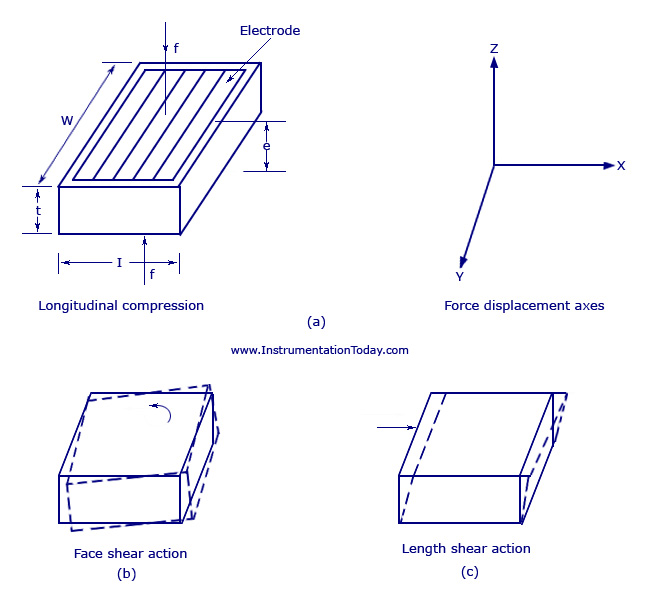
A piezoelectric transducer may be operated in one of the several modes as shown in the figure below.

Piezoelectric Crystal
                                                    Piezoelectric Crystal

Piezoelectric Transducer

The main principle of a piezoelectric transducer is that a force, when applied on the quartz crystal, produces electric charges on the crystal surface.  The charge thus produced can be called as piezoelectricity. Piezo electricity can be defined as the electrical polarization produced by mechanical strain on certain class of crystals. The rate of charge produced will be proportional to the rate of change of force applied as input. As the charge produced is very small, a charge amplifier is needed so as to produce an output voltage big enough to be measured. The device is also known to be mechanically stiff. For example, if a force of 15 kiloN is given to the transducer, it may only deflect to a maximum of 0.002mm. But the output response may be as high as 100KiloHz.This proves that the device is best applicable for dynamic measurement.

The figure shows a conventional piezoelectric transducer with a piezoelectric crystal inserted between a solid base and the force summing member. If a force is applied on the pressure port, the same force will fall on the force summing member. Thus a potential difference will be generated on the crystal due to its property. The voltage produced will be proportional to the magnitude of the applied force.

Piezoelectric Transducer
                        Piezoelectric Transducer

Piezoelectric Transducer can measure pressure in the same way a force or an acceleration can be measured. For low pressure measurement, possible vibration of the amount should be compensated for. The pressure measuring quartz disc stack faces the pressure through a diaphragm and on the other side of this stack, the compensating mass followed by a compensating quartz.

Applications

  1. Due to its excellent frequency response, it is normally used as an accelerometer, where the output is in the order of (1-30) mV per gravity of acceleration.
  2. The device is usually designed for use as a pre-tensional bolt so that both tensional and compression force measurements can be made.
  3. Can be used for measuring force, pressure and displacement in terms of voltage.

Advantages

  1. Very high frequency response.
  2. Self generating, so no need of external source.
  3. Simple to use as they have small dimensions and large measuring range.
  4. Barium titanate and quartz can be made in any desired shape and form. It also has a large dielectric constant. The crystal axis is selectable by orienting the direction of orientation.

Disadvantages

  1. It is not suitable for measurement in static condition.
  2. Since the device operates with the small electric charge, they need high impedance cable for electrical interface.
  3. The output may vary according to the temperature variation of the crystal.
  4. The relative humidity rises above 85% or falls below 35%, its output will be affected. If so, it has to be coated with wax or polymer material.

Capacitive Transducers

in Transducers / 10 Comments

To learn about a capacitive transducer, it is important to know the basics of a parallel plate capacitor. Being the simplest form of a capacitor, it has two parallel conducting plates that are separated to each other by a dielectric or insulator with a permittivity of Ε (for air). Other than paper, vacuum, and semi-conductor depletion region, the most commonly used dielectric is air.

Due to a potential difference across the conductors, an electric field develops across the insulator. This causes the positive charges to accumulate on one plate and the negative charges to accumulate on the other. The capacitor value is usually denoted by its capacitance, which is measured in Farads. It can be defined as the ratio of the electric charge on each conductor to the voltage difference between them.

The capacitance is denoted by C. In a parallel plate capacitor, C = [A*Er*9.85*1012 F/M]/d

A – Area of each plate (m)

d – Distance between both the plates (m)

Er – Relative Dielectric Constant

The value 9.85*1012 F/M is a constant denoted by Eo and is called the dielectric constant of free space.
From the equation it is clear that the value of capacitance C and the distance between the parallel plates,d are inversely proportional to each other. An increase of distance between the parallel plates will decrease the capacitance value correspondingly. The same theory is used in a capacitive transducer. This transducer is used to convert the value of displacement or change in pressure in terms of frequency.

You may also like: Capacitance Transducer

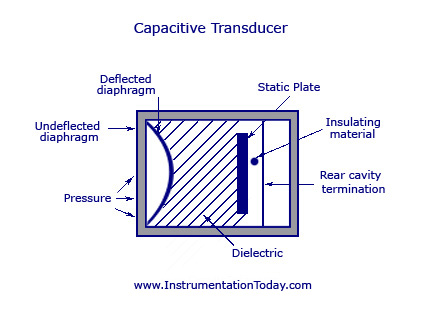
As shown in the figure below, a capacitive transducer has a static plate and a deflected flexible diaphragm with a dielectric in between. When a force is exerted to the outer side of the diaphragm the distance between the diaphragm and the static plate changes. This produces a capacitance which is measured using an alternating current bridge or a tank circuit.

Capacitive Transducer
                                 Capacitive Transducer

A tank circuit is more preferred because it produces a change in frequency according to the change in capacitance. This value of frequency will be corresponding to the displacement or force given to the input.

Advantages

  • It produces an accurate frequency response to both static and dynamic measurements.

Disadvantages

  • An increase or decrease in temperature to a high level will change the accuracy of the device.
  • As the lead is lengthy it can cause errors or distortion in signals.