UXDE dot Net Wordpress Themes

Yearly Archives: 2011

Radiation Pyrometer

in Transducers / 6 Comments

As discussed earlier, an Optical Pyrometer can be not only be used for temperature measurement, but also can be used to see the heat that is measured. The observer is actually able to calculate the infrared wavelength of the heat produced and also see the heat patterns by the object. But the amount of heat that the device can sense is limited to 0.65 microns. This is why the radiation pyrometer is more useful, as it can be used to measure all temperatures of wavelengths between 0.70 microns and 20 microns.

Radiation Pyrometer

The wavelengths measured by the device are known to be pure radiation wavelengths, that is, the common range for radioactive heat. This device is used in places where physical contact temperature sensors like Thermocouple, RTD, and Thermistors would fail because of the high temperature of the source.

The main theory behind a radiation pyrometer is that the temperature is measured through the naturally emitted heat radiation by the body. This heat is known to be a function of its temperature. According to the application of the device, the way in which the heat is measured can be summarized into two:

  1. Total Radiation Pyrometer – In this method, the total heat emitted from the hot source is measured at all wavelengths.
  2. Selective Radiation Pyrometer – In this method, the heat radiated from the hot source is measured at a given wavelength.

As shown in the figure below, the radiation pyrometer has an optical system, including a lens, a mirror and an adjustable eye piece. The heat energy emitted from the hot body is passed on to the optical lens, which collects it and is focused on to the detector with the help of the mirror and eye piece arrangement. The detector may either be a thermistor or photomultiplier tubes. Though the latter is known for faster detection of fast moving objects, the former may be used for small scale applications. Thus, the heat energy is converted to its corresponding electrical signal by the detector and is sent to the output temperature display device.

Radiation Pyrometer
                                            Radiation Pyrometer

Advantages

  • The device can be used to measure very high temperatures without direct contact with the hot source (Molten metal).
  • The biggest advantage is that the optical lens can be adjusted to measure temperature of objects that are even 1/15 inch in diameter and that too kept at a long s=distance from the measuring device.
  • The sight path of the device is maintained by the construction of the instrument components, such as the lens and curved mirrors.

Optical Pyrometer

in Transducers / 21 Comments

Pyrometer

A pyrometer is a device that is used for the temperature measurement of an object. The device actually tracks and measures the amount of heat that is radiated from an object. The thermal heat radiates from the object to the optical system present inside the pyrometer. The optical system makes the thermal radiation into a better focus and passes it to the detector. The output of the detector will be related to the input thermal radiation. The biggest advantage of this device is that, unlike a Resistance Temperature Detector (RTD) and Thermocouple, there is no direct contact between the pyrometer and the object whose temperature is to be found out.

Optical Pyrometer

In an optical pyrometer, a brightness comparison is made to measure the temperature. As a measure of the reference temperature, a color change with the growth in temperature is taken. The device compares the brightness produced by the radiation of the object whose temperature is to be measured, with that of a reference temperature. The reference temperature is produced by a lamp whose brightness can be adjusted till its intensity becomes equal to the brightness of the source object. For an object, its light intensity always depends on the temperature of the object, whatever may be its wavelength. After adjusting the temperature, the current passing through it is measured using a multimeter, as its value will be proportional to the temperature of the source when calibrated. The working of an optical pyrometer is shown in the figure below.

Optical Pyrometer - Working

Optical Pyrometer - Working

As shown in the figure above, an optical pyrometer has the following components.

  1. An eye piece at the left side and an optical lens on the right.
  2. A reference lamp, which is powered with the help of a battery.
  3. A rheostat to change the current and hence the brightness intensity.
  4. So as to increase the temperature range which is to be measured, an absorption screen is fitted between the optical lens and the reference bulb.
  5. A red filter placed between the eye piece and the reference bulb helps in narrowing the band of wavelength.

Working

The radiation from the source is emitted and the optical objective lens captures it. The lens helps in focusing the thermal radiation on to the reference bulb. The observer watches the process through the eye piece and corrects it in such a manner that the reference lamp filament has a sharp focus and the filament is super-imposed on the temperature source image. The observer starts changing the rheostat values and the current in the reference lamp changes. This in turn, changes its intensity. This change in current can be observed in three different ways.

1. The filament is dark. That is, cooler than the temperature source.

2. Filamnet is bright. That is, hotter than the temperature source.

3. Filament disappears. Thus, there is equal brightness between the filament and temperature source. At this time, the current that flows in the reference lamp is measured, as its value is a measure of the temperature of the radiated light in the temperature source, when calibrated.

Optical Pyrometer-Temperature Measurement
                                   Optical Pyrometer-Temperature Measurement

Advantages

  1. Simple assembling of the device enables easy use of it.
  2. Provides a very high accuracy with +/-5 degree Celsius.
  3. There is no need of any direct body contact between the optical pyrometer and the object. Thus, it can be used in a wide variety of applications.
  4. As long as the size of the object, whose temperature is to measured fits with the size of the optical pyrometer, the distance between both of them is not at all a problem. Thus, the device can be used for remote sensing.
  5. This device can not only be used to measure the temperature, but can also be used to see the heat produced by the object/source. Thus, optical pyrometers can be used to measure and view wavelengths less than or equal to 0.65 microns. But, a Radiation Pyrometer can be used for high heat applications and can measure wavelengths between 0.70 microns to 20 microns.

Disadvantages

  1. As the measurement is based on the light intensity, the device can be used only in applications with a minimum temperature of 700 degree Celsius.
  2. The device is not useful for obtaining continuous values of temperatures at small intervals.

Applications

  1. Used to measure temperatures of liquid metals or highly heated materials.
  2. Can be used to measure furnace temperatures.

Thermocouple

in Transducers / 4 Comments
Thermocouple
                                                       Thermocouple

A thermocouple is a temperature sensor that has a pair of dissimilar metals joined together at one end and terminated at the other end. The joined end is called the sensing junction or hot junction and the terminated end is called the reference junction or cold junction. The temperature at the reference junction is called reference temperature and is always maintained constant.  When the sensing junction and the reference junction are at different temperatures, a potential difference is obtained and this causes a flow of current in the circuit. The thermoelectric voltage produced is due to the different binding energies of the electrons to the metal ions. This voltage depends on the metals themselves, and in addition on the temperature. The thermal voltage is produced only because of the closed circuit between the two metals. This phenomenon is called “Seebeck Effect”.

The wires must be electrically separated beyond the measuring junction.  If the reference junction is kept at a standard temperature, usually 32°F, then a given pair of metals will have a unique variation of EMF as the measuring-junction temperature is changed (note that at 32o F there is no EMF generated).  This variation can also be called thermocouple calibration, and is shown in the figure below for its different types.

Circuit for Temperature Measurement by Thermocouple
                   Circuit for Temperature Measurement by Thermocouple
Thermocouple Temperature-EMF Graph
                                     Thermocouple Temperature-EMF Graph

Thermocouple Measurement

Thermocouple measurement is explained along with a figure shown below. The figure shows a thermocouple circuit with T2 at 32°F (0° C). This temperature is maintained with the help of an ice-bath reference junction.  The thermocouple circuit ends in the ice-bath,  the generated EMF flow through standard copper wire until it reaches its final destination, – a millivolt meter type instrument.  The millivolt value sensed by this instrument is then converted into a temperature T1. Tables are available for every commercially used thermocouple material combination and they are based on the reference junction temperature of 0°C/32°F.

Thermocouple Measurement
                                                  Thermocouple Measurement

Thermocouple Types

There are a lot of thermocouple material types and these combinations are approved and standardized by the American National Standard ISA MC 96.1: “Temperature Measurement Thermocouples” in USA.  The standards must be followed for the different device designations as well as its color coding.

According to ISA MC96.1 standards, the thermocouple can be designated with the different combinations of letters like “E”, “J”, “K”, “T”, ”S”, ”R”. Four of the most popular thermocouple wire combinations are almost always identified by their trade names:

  • Thermocouple Type E    is a combination of Chromel (Nickel-Chromium) and Constantan (Copper-Nickel).
  • Thermocouple Type J is a combination of Iron and Constantan.
  • Thermocouple Type K    is a combination of Chromel (Nickel-Chromium) and Alumel (Nickel Aluminium).
  • Thermocouple Type T is a combination of Copper and Constantan.
  • Thermocouple Type S is a combination of Platinum 10% rhodium and Platinum.
  • Thermocouple Type R    is a combination of Platinum 13% rhodium and Platinum.

Extension Wires

Thermocouple wires are expensive because they are fabricated to very stringent quality control requirements.  Therefore, it is customary to change to so-called “thermocouple extension” wires at the closest (to the point of measurement or hot junction) convenient connection point.  These connection points must be isothermal to each other.  These thermocouple extension wires are less expensive because they are fabricated to less stringent quality requirements.

 Color Coding

In order to distinguish among different types of thermocouple wires their insulation is color-coded.as per the standards of ISA MC 96.1.The different thermocouple conductor combinations, their operating ranges, and color coding as per the international standards are shown below.

Thermocouple Conductor-Combinations,Operating Range, and Colour Coding

Thermocouple Conductor-Combinations,Operating Range, and Colour Coding

Thermocouple Junctions

A thermocouple used for industrial applications has three junctions. They are

1. Exposed Junction – This junction is directly exposed to the environment. As a result its life is very less. Though it has a very high response time, it is not frequently used.

2. Ungrounded Junction – This junction has very minimum response time, but is known for its incredible electro-magnetic shielding properties. It is used mostly for the measurements on electrical equipment, but is usually suitable for many process applications as well.

3. Grounded Junction – The response time of this is more than ungrounded junctions and also provides good shielding properties for most process applications.  It is preferred for most of the oil and gas industries and process industries for control applications because of its speed of response.

The figures of grounded junction, ungrounded junction and exposed junction are shown under the heading ‘thermocouple grounding’

Thermocouple Probes

Sometimes, a thermocouple has to be installed inside a Thermowell for providing protection. This is applicable only in cases where the temperature of a fluid flowing inside a pipe is to be measured. To do so, a probe is to be sheathed and enclosed in a corrosion resistant tube. Typically, the sheath should be a quarter inch in diameter and the probe should be spring-loaded so as to make a strong contact with the bottom of the Thermowell.  A screw-cover head is used for electrical connections.  In the probe the thermocouple wires are separated from each other and the sheath by means of ceramic insulation material such as Magnesium Oxide (MgO) or Aluminum Oxide (Al2O3).

Some variations of thermocouple probe are explained below.

Clamp-on Thermocouples – As the name suggests they are clamped to a pipe, and thus presses the measuring junction against the pipe. This method is applicable only in places where a temperature measurement is desired for which normal provision was not previously made.  This thermocouple may be useful in trouble-shooting a process. The output may not be so accurate unless the point of measurement and the surrounding area are well insulated from the outer environment. Another type of the clamp-on thermocouple is the skin couple that is used mostly to measure furnace tube and reactor surface temperatures. Skin couples can either be tack welded to the surface being measured (furnace tubes) or clamped on (reactor walls).

The figure below shows a washer type thermocouple that is to be installed on the pipeline and temperature transmitter for this application.

Washer Type Thermocouple
                                      Washer Type Thermocouple

Many types of clamp-on and surface thermocouples are present in the market and they are selected according to the requirement. Pad type thermocouples are used for surface temperature measurement. Its application can be seen in temperature measurement of heater tubes. These are installed on pipe lines and heater tubes by means of welding.

Duplex Thermocouples – Duplex thermocouples are very similar to the conventional thermocouple except that this device has two pairs of thermocouple wires in the measuring junction. There may be two Alumel and two Chromel wires, joined together and the wires are brought out in two separate circuits to provide two individual measurements.  The two temperature readings should then be identical, assuming that both circuits are otherwise similar.  This may be useful for checking one instrument against the other, especially by using a test voltmeter locally to determine whether a remote reading is inaccurate because of the instrument or because of circuit problems.

As the whole device can be made in one assembly, the cost of production is very less. But, if either one of the two thermocouple circuits fail due to measuring junction problems or short circuit, the whole device will have to be replaced. Thus, it is less reliable than two single thermocouples. Furthermore, if one pair of a duplex thermocouple is used for checking, then there is a risk of shorting or grounding the other pair of wire.

Thermocouple Grounding

Thermocouple circuits can be either grounded or ungrounded (floating or insulated). Generally grounded thermocouple circuits are recommended for personnel safety, to reduce the effects of electrical noise and provide good thermal response characteristics. Ungrounded thermocouples should be considered for applications where equipments are likely to get damaged due to ground faults or lightening strikes particularly in tank farm areas.

Thermocouple grounding should be done to the low- or negative-potential side of the circuit, and should be done at the source rather than at the secondary instrument in order to achieve maximum rejection of common-mode noise.  There is a normal practice that any electrical or electronic circuit should be grounded at only one point s as to avoid a ground current in the circuit. With this rule in mind, thermocouple grounding is carried out in one of the following ways – It is always good practice to ground the thermocouple measuring junction or ground the thermocouple elsewhere than at the measuring junction.

Thus, thermocouples can be classified according to the manner in which they are grounded.

Thermocouples may be either:

  • Intentionally grounded
  • Intentionally ungrounded
  • Unintentionally grounded – This is used in places where a bad contact or no contact of the measuring junction with a well occurs or because of formation of a high-resistance chemical film at the measuring junction.

The different combinations of thermocouple type, grounded intermittently /unintentionally grounded, or ungrounded; of secondary instrument type, isolated input/output or not; and of output grounding are shown in the figures below.

Grounding of Thermocouple Systems
                         Grounding of Thermocouple Systems

Points

  • PT:1    Interconnection of shield and thermocouple is not applicable if shield is not required.
  • PT:2    The ground may be located  anywhere on the line.
  • PT:3   Grounding the thermocouple may be done by connecting to the thermocouple head or junction box screw, assuming that these are grounded. Otherwise, connect the thermocouple to any other point that is grounded.
  • PT:4   Ground the thermocouple through a resistor if circuit operation shows a need for improvement in repeatability AND/OR noise rejection. If used, the resistor may be approximately 100,000  ohms, ½ watt, carbon type.
  • PT:5   If the thermocouple, proper, is grounded, then the remainder of the circuit, from thermocouple to receiver, if any, shall not be grounded. Alternatively, if another ground exists, then the thermocouple, proper shall not be grounded.
  • PT:6   If the secondary instrument is not a transmitter, but of a type, such as a recorder, that does not have a measurement output, then the output lines and associated  details on the diagram should  be ignored.
  • PT:7   Ground the shield ,if any at that point that is closest to the signal ground.

Thermocouple systems used with DCS are shown below.

Grounded Thermocouple and Ungrounded Thermocouple

Shielding

The device could be interfered by external noises from different sources like electrostatic fields, magnetic fields and common mode interference. Electrostatic fields originate from voltage sources that are capacitively coupled to the thermocouple extension wire. Varying electrostatic fields, usually originating from AC conductors, produce a capacitive current flowing through the coupling path to the signal conductors.

The best way to minimize the interference of such electrostatic fields is to cover the thermocouple wires with a grounded metal shield. The capacitive current flow will flow through this shield to the ground.  The purpose of the shield is to remain at or near ground potential, and thereby couple no signal to the signal wires contained within the shield, since there is no difference in voltage.  Note that a shield that is not grounded provides no protection.

A varying magnetic field (such as the one produced by AC current in a power cable) may cause interference to thermocouple signals by generating small currents in the signal wire by induction.  The magnitude of the induced current is a function of the field strength and the dimensions of the conductive loop into which the current is being induced. Twisted conductors are effective at reducing the induced currents by alternating the polarity of the induced current with each half twist to cancel out most of the induction. Note this effect occurs whether the thermocouple wire is shielded or not.

Common mode interference generates noise that is identical in both conductors of a twisted pair with respect to ground.

Thermocouple Head and Connectors

The most frequently used thermocouple assemblies/probes are provided with a thermocouple head that is the screw-cover type; is weather-proof, high-temperature provided with gaskets; has terminal block for single or duplex thermocouple, as appropriate. The cable entry shall be as per specific project requirement. The terminal shall be ceramic based spring loaded type.

Advantage

  • Fast Response
  • Suitability for remote measurement
  • Wide Range
  • Freedom of effect by wire length and diameter provided that a high-impedance secondary instrument is used.

Disadvantage

  • Need for cold-junction compensation
  • Susceptibility to error from extension wire termination temperature gradient
  • Possible sensitivity to signal noise
  • Need for secondary instrument
  • Need for thermocouple transmitter on long runs
  • Need to avoid intermediate junctions of dissimilar metals
  • Inability to accurately measure temperature over a narrow span

Thermopile

Like a thermocouple, a thermopile is also a device that is used to measure temperature in terms of electrical energy. The device is actually a combination of a number of thermocouples in series or parallel connection. Series connection is commonly used for most applications.

The device is capable of generating an output voltage, that will be a measure of the temperature difference or temperature gradient. Its response to absolute temperature is minimum. The output is in the range of millivolts.

The device finds its application as a part of temperature sensors, like the infrared thermometer, a device used to calculate body temperature. They are also used as safety controls in heat burners and heat flux sensors. They can also be used to produce electrical energy, that is, by dissipating the heat from electronic devices. It is also used for spatial temperature averaging.

Thermistor

in Transducers / 5 Comments

Thermistor is a resistance thermometer, similar to a Resistance Temperature Detector (RTD) and is used for temperature measurement. It consists of a non-metallic resistor that is used as the temperature sensing element.

Thermistor Symbol
                 Thermistor Symbol

Thermistor is the short form for ‘Thermal Resistor’. The device consists of a bulk semiconductor device that acts as a resistor with a high and negative temperature co-efficient of resistance, sometimes as high as -6% per degree Celsius rise in temperature. Due to this property of high sensitivity (that is, huge resistance change for a small change in temperature), the thermistor is mainly applicable in precision temperature measurement, temperature control, and temperature compensation, especially in a lower temperature range of -100 degree Celsius to +300 degree Celsius.

Difference between Thermistor and Resistance Temperature Detectors (RTD)

Both devices work on the same principle that a constant current flowing through the resistor, and its changing resistance due to change in temperature, is measured as a voltage drop across it. The main difference is that the electrical resistance of the resistor used in a thermistor varies in a non-linear manner with respect to temperature. The sensing element used in the thermistor is made up of either a ceramic or polymer, while RTD uses pure metals as its sensing element. Another major difference is in its operating range. Due to its high sensitivity, thermistors are used in narrow span measurements and low temperature ranges from -20 degree Celsius to +120 degree Celsius. But RTD’s are used over wide and larger temperature ranges.

Construction

The device is manufactured from materials like sintered mixtures of oxides of metals such as manganese, nickel, cobalt, and iron. Their resistances range from 0.4 ohms to 75 mega-ohms and they may be fabricated in wide variety of shapes and sizes. Smaller thermistors are in the form of beads of diameter from 0.15 millimeters to 1.5 millimeters.  Such a bead may be sealed in the tip of solid glass rod to form probe which is easier to mount than bead. Alternatively thermistor may be in the form of disks and washers made by pressing thermistor material under high pressure into flat cylindrical shapes with diameter from 3 millimeters to 25 millimeters. Washers may be stacked and placed in series or parallel to increase power disciplining capability.

Characteristic Curve

The resistance versus temperature curve is one of the main characteristics that is used in measurement, control and compensation applications using a thermistor. The characteristics graph is shown below.

Resistance Versus Temperature Characteristics of Thermistor

From the characteristics graph of a typical thermistor, we can see that the resistivity changes from 107 to 1 ohm-cm as the temperature changes from -100 degree Celsius to +400 degree Celsius. This high negative temperature coefficient of resistance makes thermistor an ideal temperature transducer.

Thermistor as Temperature Sensor

A thermistor used for the measurement of temperature is shown in the figure below. The thermistor is designed to have a resistance of 2 kilo-ohms at 25 degree Celsius and temperature coefficient of -4% per degree Celsius will bring a reduction of 80 ohms per degree Celsius change in temperature.

The device is connected in series to a battery and a micrometer. A change in temperature causes a change in the resistance if the thermistor and the corresponding micrometer current reading is noted. Usually, the meter is calibrated in terms of temperature with 0.1 degree Celsius resolution. As shown in the figure, a bridge circuit is also used so as to increase the thermistors sensitivity.

Thermistor Types

For studying about the different types of thermistors, it is important to understand the formula which shows the linear relationship between resistance and temperature.

As a 1st order approximation, the change in resistance is equal to the 1st order temperature co-efficient of resistance times the change in temperature.

dR = k.dT

where, dR – Change in Resistance

k – 1st Order Temperature Coefficient of Resistance

dT – Change in Temperature

If the value of temperature coefficient of resistance (k) is positive, an increase in temperature increases the resistance. Such a device can be called a Posistor or Positive Temperature Coefficient Thermistor (PTC). If the value of k is negative, an increase in temperature will decrease the resistance value. Such a device is called a Negative Temperature Coefficient Thermistor (NTC).

Posistor/Positive Temperature Coefficient (PTC) Thermistors

PTC Thermistors that are used in industries are broadly classified into two. The first one is called by the name ‘Silistors’, as to Sensitive Silicon Resistors. Silistors are known to have a positive temperature coefficient of 08% per degree Celsius. If the temperature goes higher than 175 degree Celsius, the device jumps to a negative temperature coefficient region. The other classification of PTC Thermistors is called Switching Type PTC Thermistors. It is made from ceramic type materials and are known to have a very high resistance from a small change in temperature. Dopant’s are also added to the material so that they show a semi-conductive behavior as well. The device is known to have a transition or “Curie” temperature. Until the device reaches that particular point, it shows a negative temperature co-efficient pattern in its resistance-temperature characteristics. After this point, it starts to show an increasing positive temperature coefficient of resistance. At this point, the resistance also begins to develop. The main difference in the temperature-resistance curve between a silistor and switching PTC Thermistor is shown below.

Resistance Temperature Characteristic of Silistor and Switching Type PTC

Applications

  1. The device is famous for its application as a circuit protecting device, such as a fuse. The flow of current through the device causes a heat to build up due to its resistive property. Thus, if excessive current flows through the device, the device begins to heat up accordingly and thus increases its resistance. This increase in resistance again builds up more heat. This creates such an effect that develops more resistance in the device, and limits the amount of voltage and current in the device.
  2. Another major application is as a timer in degaussing coil circuit of CRT monitors. When a CRT monitor is turned on, an initial current reaches the PTC thermistor and degaussing coil. The PTC thermistor will be of large size and thus, the resistance of the device increases as the current flows in. This causes the heat to build up and thus the degaussing coil shuts off very fast. The degaussing coil is necessary to decrease the continuous magnetic field in a smooth manner. This help can be provided only by the PTC thermistor.

Negative Temperature Coefficient (NTC) Thermistors

NTC Thermistors that are used in industries are broadly classified into two. Thus classification is based on the method by which the electrodes are placed on the ceramic body. This main category could be further divided depending on the different types of geometries, shapes and processing methods. One of the main categories that is most commonly used in the industries is the bead type thermistors.  According to the shape and manufacturing methods, bead thermistors can be again classified into Bare Beads, Glass Coated Beads, Ruggedized Beads, and Bead in glass Enclosures and many more.

Another group of NTC Thermistors is the ones with metalized surface contacts. These thermistors can be mounted using spring contacts or by surface mounting.

Applications

  1. NTC thermistors are used for temperature measurements (usually in a narrow span and low temperature ranges).
  2. The device can be used to limit the sudden over current that flows in supply circuits. The device is known to have a very high value of resistance in the beginning. The resistance gradually decreases by the heating up of the device. As the resistance decreases, the usual operation of the circuit is restored and the high current flows through it without damaging other parts of the circuit.
  3. This device is used to measure the temperature of incubators.
  4. NTC thermistors are used to measure and monitor batteries while they are kept for charging.
  5. They are used to know the temperature of oil and coolant used inside automotive engines. This information is sent back to the driver through indirect ways.

Temperature Sensors

in Transducers / 1 Comment

Transducer have been devised which produce either changes in voltage or change in impedance whenever the temperature changes. Temperature measurement sensors can be divided into two categories. They are – Measurement using change in resistance and measurement using change in voltage.

The temperature sensor that uses change in resistance to measure temperature is called a resistance thermometer. Resistance thermometer can be further classified into Resistance Temperature Detectors (RTD) and Thermistor.

The temperature sensors that use change in voltage to measure temperature are Thermocouple and Thermopile

Some other types of temperature sensors are

  1. Optical Pyrometer
  2. Radiation Pyrometer
  3. Thermowells
  4. Bimetallic Thermometer
  5. Filled System Temperature Measurement

Temperature Parameters

Before going into detail, it is important to know some of the basic temperature parameters and instrumentation systems.

  1. Range: The range of a temperature measuring device is the maximum and minimum temperature it can indicate, record, measure or transmit. The range should be decided in such a manner that the normal operating temperature is almost (50-70)% of the full scale with the maximum temperature range close to, but more than the upper range of scale.
  2. Span: The difference between the maximum and minimum values of temperature in the calibrated range is called span. It is always good to have very low values of span. The minimum span is the smallest range that the manufacturer can accurately calibrate within the device’s range.
  3. Turndown: It is the ratio of maximum measurable parameter to minimum measurable parameter.
  4. Immersion Length: The immersion length of a Thermowell is the distance between the free end/tip of the Thermowell and the point of immersion in the medium that is being measured.  The standard symbol for the immersion length of a Thermowell is “R”.
  5. Insertion Length: The insertion length of a Thermowell is the distance between the free end/tip of a Thermowell and (but not including) the external threads of other means of attachment to a vessel.  The standard symbol for the insertion length of a Thermowell is “U”.

Temperature

The term ‘temperature’ can be defined in terms of heat. Heat is a measure of the energy contained in a body, which is due to the irregular motion of its molecules or atoms. The internal energy of body or gas increases with increasing temperature. Temperature is a variable which together with other parameters such as mass, specific heat etc. describe the energy content of a body. When energy in the form of heat is introduced to or extracted from a body, altered molecular activity will be made apparent as a temperature change.

To measure the value of temperature, some of the following phenomenon is needed.

  • Change in physical dimensions or characteristics of liquids, metals, or gases
  • Changes in electrical resistance
  • Thermoelectric effect
  • Radiant energy

Bimetallic Thermometer

In an industry, there is always a need to measure and monitor temperature of a particular spot, field or locality. The industrial names given to such temperature sensors are Temperature Indicators (TI) or Temperature Gauges (TG). All these temperature gauges belong to the class of instruments that are known as bimetallic sensors.

Two basic principles of operation is to be followed in the case of a bimetallic sensor. They are

  1. A metal tends to undergo a volumetric dimensional change (expansion/contraction), according to the change in temperature.
  2. Different metals have different co-efficient of temperatures. The rate of volumetric change depends on this co-efficient of temperature.

Working

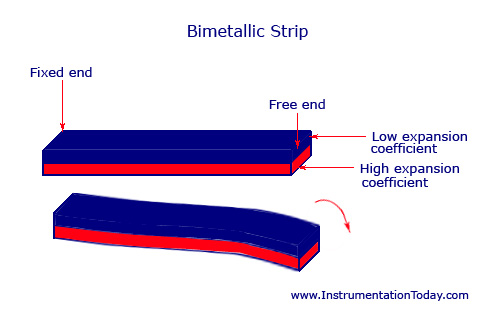
The device consists of a bimetallic strip of two different metals and they are bonded together to form a spiral or a twisted helix. Both these metals are joined together at one end by either welding or riveting. It is bonded so strong that there will not be any relative motion between the two. The image of a bimetallic strip is shown below.

Bimetallic Strip
                                                    Bimetallic Strip

A change in temperature causes the free end of the strip to expand or contract due to the different co-efficients of expansion of the two metals. This movement is linear to the change in temperature and the deflection of the free end can be read out by attaching a pointer to it. This reading will indicate the value of temperature. Bimetallic strips are available in different forms like helix type, cantilever, spiral, and also flat type.

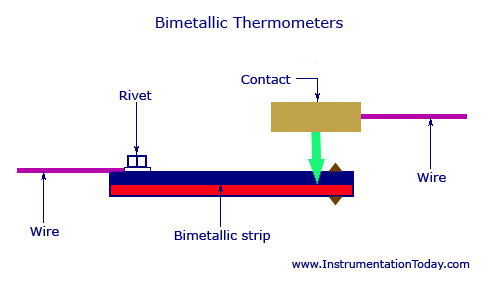
The figure below shows the working of a bimetallic sensor. Two metals, blue and red are riveted together. If it is used in an oven, the red metal would expand faster than the blue metal. If it is used in a refrigerator, a rise in temperature causes the blue metal to expand faster than the red one. As a result the strip will bend upward and short circuits with a metal wore so that current begins to flow. If the size of the gap between the strip and the wire is adjusted, you can control the temperature.

Bimetallic Thermometer
                                      Bimetallic Thermometer

Bimetallic thermometers are generally available with 2, 3, 4, 5 or 6-inch concentric dials, preferably of the non-parallax type (i.e. not visually misaligned or displaced), with external zero adjustment, and 1/2-inch mounting thread.  The stem should be of Stainless Steel SS316), having a 1/4-inch diameter, and of a customized length to suit process requirements. The dial orientation may be bottom or back, known as “straight” or “angle”, respectively.  However, an all angle adjustable swivel connection is preferred in order to enable the dial to be read from the most convenient location.

 Bimetallic thermometers are not recommended for continued use above 420 degree Celsius. The thermal stability of the bimetallic thermometer is an inherent characteristic of the metals used and continued operation cannot be assured above 471°C.

Selection of Temperature Measurement Devices

Usually a given temperature measurement can be satisfactorily made by several different types of temperature sensing devices.  Ranges and capabilities of the various temperature measuring devices overlap in many instances. The following shall be used as guidelines for selection of Temperature Elements.

1. Bimetallic Thermometers

If the temperature to be measured is not required for automatic control, recording, or indication in the control room, a bimetallic thermometer should be used.

2. Filled System Thermometers

Occasionally a temperature transmitter, recorder and/or controller has to be installed in a location or under circumstances where electrical power is not available or inconvenient to use, while instrument air (at 20 psig or above) is present.  Under these circumstances, a filled system thermometer is an ideal choice because it can be combined with a commercially available pneumatic transmitter, recorder and/or controller.  If a local temperature measurement is in an inaccessible location so that a bimetallic thermometer cannot be easily read, a filled system thermometer is recommended because its capillary tubing can be led to an indicator that can be installed/located in a convenient place.

A liquid filled thermometer should be considered for corrosive areas or where vibration is a problem.

3. Thermocouples

Thermocouples are generally used for high temperature applications. At high temperatures there is a clear preference for thermocouples over RTDs. Project specific requirement should be checked before selection of Thermocouple or RTD for specific application.

4. Resistance Thermometers

Listed below is some temperature measurement applications for which the use of a RTD is normally preferred over a thermocouple:

  • Temperature of turbine inlet steam whose design temperature is close to the maximum allowable temperature for piping and equipment
  • Temperature of permanent turbine test points
  • Average temperature of nuclear reactor coolant
  • Average combustion turbine inlet air temperature
  • Condenser cooling water inlet to outlet temperature gain
  • Motor stator winding and bearing temperatures

Thermocouples are not suitable for narrow range temperature measurements.  This is because the change in the EMF developed by a thermocouple over a narrow temperature range is very small and difficult to measure.  Therefore, for narrow spans or small temperature differences a RTD is recommended.

MEMS Accelerometer

in Transducers / 3 Comments

MEMS Devices

Micro-electro-mechanical Systems (MEMS) Technology is one of the most advanced technologies that have been applied in the making of most of the modern devices like video projectors, bi-analysis chips and also car crash airbag sensors. This concept was first explained by Professor R. Howe in the year 1989. Since then many prototypes have been released and revised and has thus become an integral part of the latest mechanical products available in the market today.

During its early stage, the MEMS chip had two parts. One part included the main structure of the chip and the other part included everything needed for signal conditioning. This method was not successful as the total space taken by the device was larger, and thus the different parts of a single chip needed multi-assembling procedures. The output obtained from such a device had less accuracy and the mounting of such a device was difficult.

As the technology became more advanced the idea of integrating multi-chips was applied on to produce a single chip MEMS with high performance and accuracy.

The main idea behind this technology is to use some of the basic mechanical devices like cantilevers and membranes to have the same qualities of electronic circuits. To obtain such a concept, micro-fabrication process must be carried out. Though an electronic process is carried out, an MEMS device cannot be called as an electronic circuit. MEMS duplicate a mechanical part and have holes, cantilevers, membranes, channels, and so on. But an electronic circuit has a firm and compact structure. To make MEMS from silicon process, the manufacturer must have a deep knowledge in electronics, mechanical and also about the materials used for the process.

Advantages

  1. MEMS device are very small and can be applicable for many mechanical purposes where large measurements are needed.
  2. The small size of the device has also helped in reducing its cost.
  3. If two or three different devices are needed to deploy a particular process, all of them can be easily integrated in an MEMS chip with the help of microelectronics. Thus, data reception, filtering, storing, transfer, interfacing, and all other processes can be carried out with a single chip.

Applications

  1. The device is highly applicable as an accelerometer, and thus can be deployed as airbag sensors or in digital cameras in order to stabilize the image.
  2. Can be used as a pressure sensor so as to calculate the pressure difference in blood, manifold pressure (MAP), and also tire pressure.
  3. It is commonly used in a gyroscope, DNA chips and also inkjet printer nozzle.
  4. Optical MEMS is used for making projectors, optical fiber switch and so on.
  5. RFMEMS is used for making antennas, filters, switches, relays, RAM’s microphones, microphones, and so on.

MEMS Accelerometer

An accelerometer is an electromechanical device that is used to measure acceleration and the force producing it. Many types of accelerometers are available in the market today. They can be divided according to the force (static or dynamic) that is to be measured. Even today, one of the most commonly used one is the piezoelectric accelerometer. But, since they are bulky and cannot be used for all operations, a smaller and highly functional device like the MEMS accelerometer was developed. Though the first of its kind was developed 25 years ago, it was not accepted until lately, when there was need for large volume industrial applications. Due to its small size and robust sensing feature, they are further developed to obtain multi-axis sensing.

Working

One of the most commonly used MEMS accelerometer is the capacitive type. The capacitive MEMS accelerometer is famous for its high sensitivity and its accuracy at high temperatures. The device does not change values depending on the base materials used and depends only on the capacitive value that occurs due to the change in distance between the plates.

If two plates are kept parallel to each other and are separated by a distance‘d’, and if ‘E’ is the permitivity of the separating material, then capacitance produced can be written as

C0 = E0.E A/d = EA/d

EA = E0EA

A – Area of the electrodes

A change in the values of E, A or d will help in finding the change in capacitance and thus helps in the working of the MEMS transducer. Accelerometer values mainly depend on the change of values of d or A.

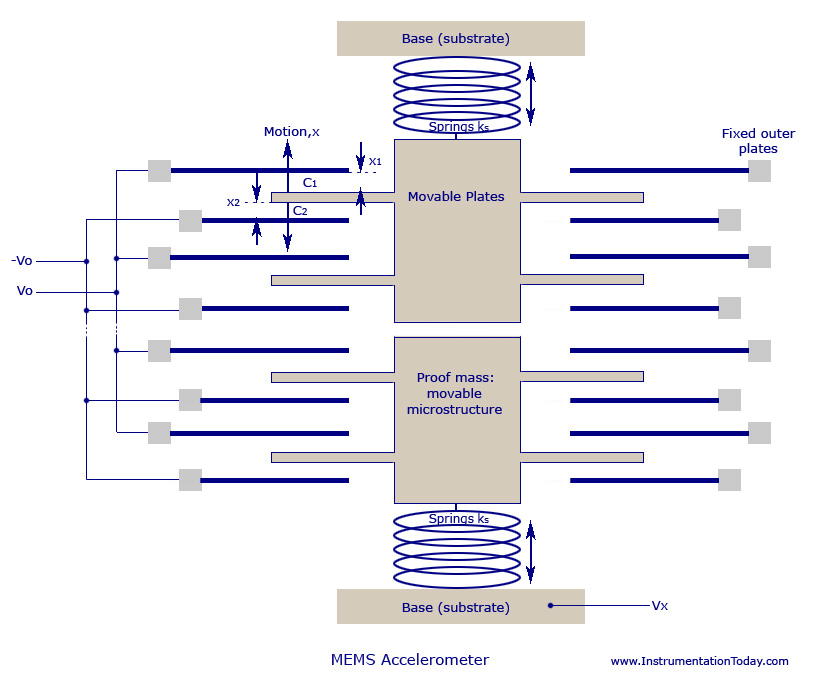
A typical MEMS accelerometer is shown in the figure below. It can also be called a simple one-axis accelerometer. If more sets of capacitors are kept in 90 degrees to each other you can design 2 or 3-axis accelerometer. A simple MEMS transducer mainly consists of a movable microstructure or a proof mass that is connected to a mechanical suspension system and thus on to a reference frame.

MEMS Accelerometer
                                                           MEMS Accelerometer

The movable plates and the fixed outer plates act as the capacitor plates. When acceleration is applied, the proof mass moves accordingly. This produces a capacitance between the movable and the fixed outer plates.

When acceleration is applied, the distance between the two plates displace as X1 and X2, and they turn out to be a function of the capacitance produced.

From the image above it is clear that all sensors have multiple capacitor sets. All upper capacitors are wired parallel to produce an overall capacitance C1 and the lower ones produce an overall capacitance of C2.

If Vx is the output voltage of the proof mass, and V0  is the output voltage produced between the plates, then

(Vx +V0) C1 + (Vx -V0) C2 = 0

We can also write

Vx =V0 [(C2-C1)/(C2+C1)] = (x/d) V0

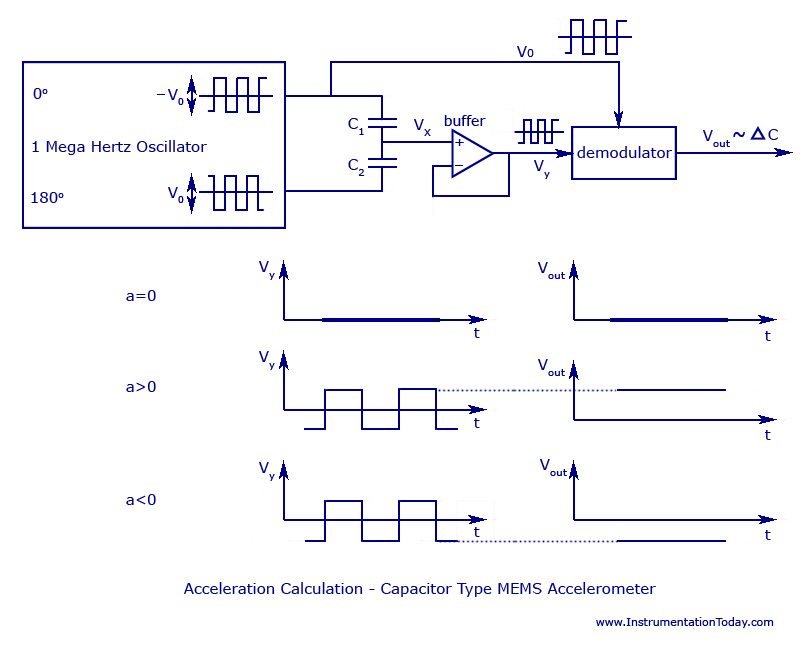
The figure below shows the circuit that is used to calculate the acceleration, through change in distance between capacitor plates. The output obtained for different values of acceleration is also shown graphically.

Capacitor Type MEMS Accelerometer
                                        Capacitor Type MEMS Accelerometer

When no acceleration is given (a=0), the output voltage will also be zero.

When acceleration is given, such as (a>0), the value of value of Vx changes in proportion to the value of V0.

When a deceleration is given, such as (a<0), the signals Vx and Vy become negative. He demodulator produces an output equal to the sign of the acceleration, as it multiplies both the values of Vy and V0 to produce VOUT, which has the correct acceleration sign and correct amplitude.

The length of the distance, d and the proof mass weigh is surprisingly very small. The proof mass weighs no more than 0.1 microgram and the output capacitance is approximately 20 aF and the plate distance is no more than 1.3 micrometers.

We must select the device in reference to its noise characteristics. If the acceleration value at low gravity condition is to be found out, the noise characteristics could easily affect its accuracy. An MEMS accelerometer is said to have three noise producing parameters – from the signal conditioning circuit, from the vibrations produced by the springs, and from the output measuring system.

MEMS Accelerometers – Applications

  1. MEMS sensors are being used in latest mobile phones and gaming joysticks as step counters, user interface control, and also for switching between different modes.
  2. Used in mobile cameras as a tilt sensor so as to tag the orientation of photos taken.
  3. To provide stability of images in camcorders and also to rotate the image to and fro when you turn the mobile.
  4. A 3D accelerometer is used in Nokia 5500 so as to provide easier tap and change feature by which you can change mp3’s by tapping on the phone when it is lying inside the pocket.
  5. Used to protect hard disk drives in laptops from getting damaged when the PC falls to the ground. The device senses the free fall and automatically switches off the hard disk.
  6. Used in car crash airbag sensors, where it senses the sudden negative acceleration and determines the correct time to open the airbag.
  7. Used in real-time applications like military monitoring, missile launching, projectiles, and so on.

Acceleration Transducer

in Transducers / 1 Comment

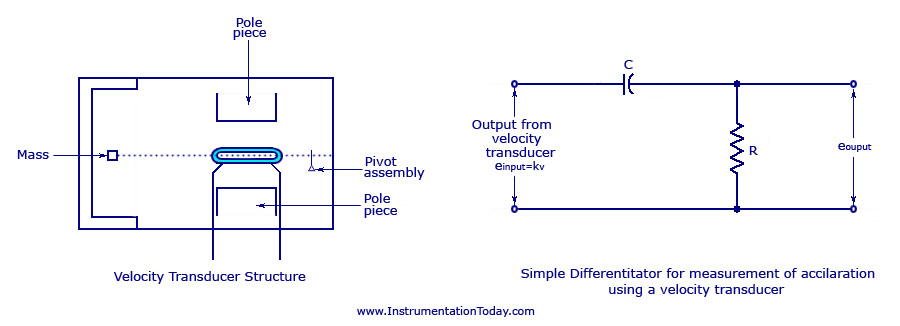
We have already discussed the working of a velocity transducer and in the topic it was explained that velocity is a time derivation of displacement and displacement is the time integral of velocity. Similarly, we can also say that acceleration is the time derivative of velocity. Thus, a velocity transducer/sensor is enough to measure acceleration. All you have to do is add a differentiator circuit to the transducer. The figure of an acceleration transducer is shown below.

Acceleration Transducer
                                                   Acceleration Transducer

The figure shows a velocity transducer with a moving coil placed in between two magnetic poles. In order to obtain a linear motion, a pivot is placed on the surface that supports tye coil. This device can be used to find both linear as well as non-linear acceleration. The output voltage is obtained according to the motion of the coil inside the magnetic field. This output voltage is given as the input of a differentiator circuit. The output voltage of a differentiator can be written as

eoutput = einput (R/(R+(1/jwc))

Over the frequency range where the value of resistance R is very small in comparison with reactance 1/wc of the capacitor, the equation can be written as

eoutput     = einput R/(R+(1/jwc))

              = kv Sin (wt).jwCR

eoutput    = kvw CR Cos (wt)

The equation shows that the output voltage is the time derivative of the input and leads the input by 90 degrees. Accordingly, the output voltage is a measure of the displacement.

Other Acceleration Transducers

Another commonly used acceleration transducer is the accelerometer. (Main Article: Accelerometer). This device is used to measure the measurable acceleration by an object instead of co-ordinate acceleration. A piezoelectric accelerometer is mostly used in industrial applications, where piezoelectric principle comes into work.Its other prototypes include Micro Electro-Mechanical System (MEMS) Accelerometer, Piezoresistive  and capacitive Acceleromter and so on.

Velocity Transducer

in Transducers / No Comments

A velocity transducer/sensor consists of a moving coil suspended in the magnetic field of a permanent magnet. The velocity is given as the input, which causes the movement of the coil in the magnetic field. This causes an emf to be generated in the coil. This induced emf will be proportional to the input velocity and thus, is a measure of the velocity. The instantaneous voltage produced is given by the equation

v=N(d∅/dt)
N – Number of turns of the coil
d∅/dt – Rate of change of flux in the coil

The voltage produced will be proportional to any type of velocities like linear, sinusoidal or random.

The damping is obtained electrically. Thus, we can assume a very high stability under temperature conditions. The basic arrangement of a velocity sensor is shown below.

Velocity Transducer Arrangement

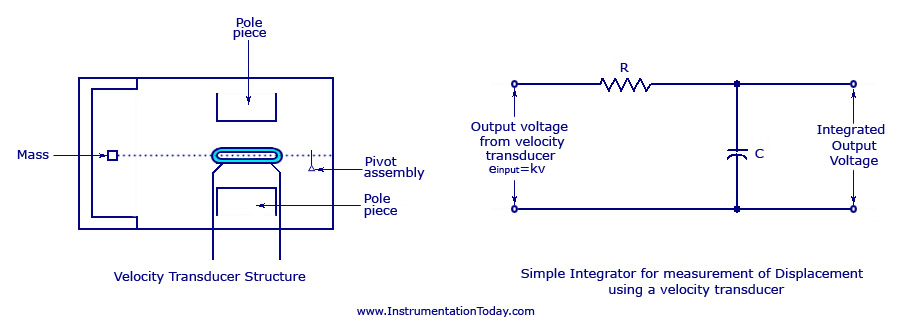
The figure shows a moving coil kept under the influence of two pole pieces. The output voltage is taken across the moving coil. The moving coil is kept balanced for a linear motion with the help of a pivot assembly.

Velocity Transducer
                                                            Velocity Transducer

Measurement of Displacement Using Velocity Transducer
We know that velocity is the derivative of displacement with respect to time. Similarly, displacement is the time integral of velocity. Thus, a velocity transducer can be used to find the displacement of an object. All we have to do is add an integrating circuit to the velocity transducer arrangement. This is shown in the figure above.
You may also like: Acceleration Transducer
The output voltage (einput) of the transducer can be represented as the product of a constant k and the instantaneous velocity v. If the velocity varies sinusoidally according to its frequency f, and has a peak value V, then the output voltage can be written as

einput = kV2πft
Capacitor Reactance Xc = 1/2πfc

When the value of frequency f is too low, the value of Xc will be very large. So, the integrated output voltage, eoutput will be proportional to einput and so will also be proportional to the velocity v. When the value of frequency becomes high, the value of Xc will become small. Thus, the integrated output voltage can be written as

eoutput = einput/JwCR
eoutput = KV/wCR Sin(wt-90°)

This shows that the value of integrator output lags behind the value of the input voltage by 90 degrees. For a given value of velocity amplitude V, the integrator output is inversely proportional to frequency w.

Strain Gauge

in Transducers / 5 Comments

Strain Gauge is a passive transducer that converts a mechanical elongation or displacement produced due to a force into its corresponding change in resistance R, inductance L, or capacitance C. A strain gauge is basically used to measure the strain in a work piece. If a metal piece is subjected to a tensile stress, the metal length will increase and thus will increase the electrical resistance of the material. Similarly, if the metal is subjected to compressive stress, the length will decrease, but the breadth will increase. This will also change the electrical resistance of the conductor. If both these stresses are limited within its elastic limit (the maximum limit beyond which the body fails to regain its elasticity), the metal conductor can be used to measure the amount of force given to produce the stress, through its change in resistance.

Strain Gauge Transducer

The device finds its wide application as a strain gauge transducer/sensor as it is very accurate in measuring the change in displacement occurred and converting it into its corresponding value of resistance, inductance or capacitance. It must be noted that the metal conductor which is subjected to an unknown force should be of finite length.

Types

Strain gauge transducers are broadly classified into two. They are

  1. Electrical Resistance Type Strain Gauge

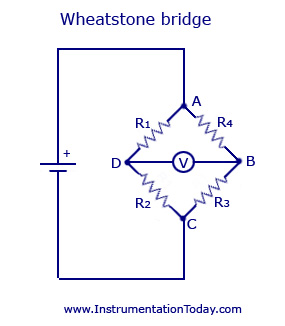
In an electrical resistance strain gauge, the device consists of a thin wire placed on a flexible paper tissue and is attached to a variety of materials to measure the strain of the material. In application, the strain gauge will be attached to a structural member with the help of special cement. The gauge position will be in such a manner that the gauge wires are aligned across the direction of the strain to be measured. The wire used for the purpose will have a diameter between 0.009 to 0.0025 centimeters. When a force is applied on the wire, there occurs a strain (consider tensile, within the elastic limit) that increases the length and decreases its area. Thus, the resistance of the wire changes. This change in resistance is proportional to the strain and is measured using a Wheatstone bridge.

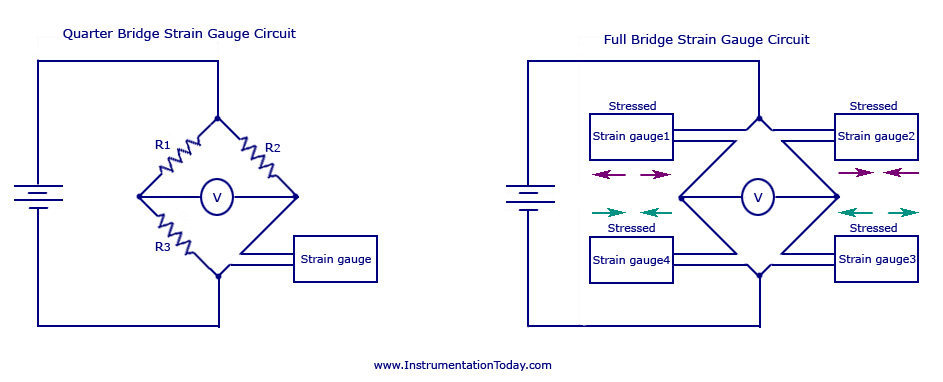
A simple Wheatstone bridge circuit is shown in the figure below. It can be set in three different ways such as – full bridge, half bridge or quarter bridge. A full bridge will have all four of its gauges active. The half bridge will have two of its gauges active and thus uses two precise value resistors. The quarter bridge will have only one gauge and the rest of the resistors will be precise in value.

Wheatstone Bridge
                Wheatstone Bridge

A full bridge circuit is used in applications where complimentary pair of strain gauges is to be bounded to the test specimen. In practice, a half bridge and full bridge circuit has more sensitivity than the quarter bridge circuit. But since, the bonding is difficult, a quarter bridge circuits are mostly used for strain gauge measurements. A full bridge circuit is said to be more linear than other circuits.

An external supply is given to the bridge as shown in the diagram. Initially, when there is no application of strain, the output measurement will be zero. Thus, the bridge is said to be balanced. With the application of a stress to the device, the bridge will become unbalanced and produces an output voltage that is proportional to the input stress.

The application of a full bridge and quarter bridge strain gauge circuit is shown in the figure below.

Quarter And Full Bridge Strain Gauge Circuit
                                 Quarter And Full Bridge Strain Gauge Circuit

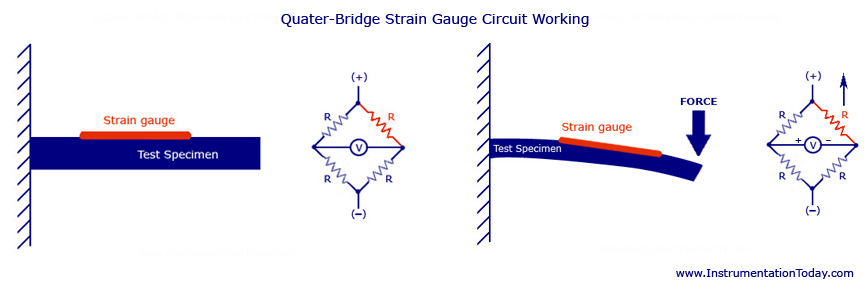
A quarter bridge output corresponding to the application of a force is shown below. Initially, the circuit will be balanced without the application of any force. When a downward force is applied, the length of the strain gauge increases and thus a change in resistance occurs. Thus an output is produced in the bridge corresponding to the strain.

Quarter Bridge Strain Gauge Circuit-Working
                                  Quarter Bridge Strain Gauge Circuit-Working

The wire strain gauge can be further divided into two. They are bonded and unbonded strain gauge.

As shown in the figure below, an unbounded strain gauge has a resistance wire stretched between two frames. The rigid pins of the two frames are insulated. When the wire is stretched due to an applied force, there occurs a relative motion between the two frames and thus a strain is produced, causing a change in resistance value. This change of resistance value will be equal to the strain input.

Unbonded Strain Gauge
                            Unbonded Strain Gauge

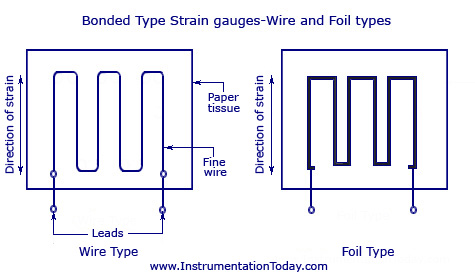
A bonded strain gauge will be either a wire type or a foil type as shown in the figure below. It is connected to a paper or a thick plastic film support. The measuring leads are soldered or welded to the gauge wire. The bonded strain gauge with the paper backing is connected to the elastic member whose strain is to be measured.

Bonded Type Strain Gauges
                                        Bonded Type Strain Gauges

According to the strain to be measured, the gauges can be classified as the following.

  • Uniaxial/Wire Strain Gauge

The figure of such a strain gauge is shown above. It mostly uses long and narrow sensing elements so as to maximize the length of the strain sensing material in the desired direction. Gauge length is chosen according to the strain to be calculated.

Gauge Configurations

Gauge Configurations

  • Biaxial Strain Gauges

When the measurement of strain is to be done in two directions (mostly at right angles), this method is used. The basic structure for this is the two element 90 planar rosette or the 90 planar shear/stacked foil rosette. The gauges are wired in a Wheatstone bridge circuit to provide maximum output. For stress analysis, the axial and transfers elements have different resistances which can be selected that the combined output is proportional to the stress while the output of the axial element alone is proportional to the strain. The figure is given below.

  • Three Element Rosettes

It is divided into two types – three element 60delta rosette strain gauge and three element 45planar rectangular rosette. They are used in applications where both the magnitude and direction of the applied strains are to be found out. Both the figures are shown below. The 60 rosette is used when the direction of the principal strain is unknown. The 45 rosette is used to determine a high angular resolution, and when the principal strains are known.

    2.   Semiconductor Strain Gauge

This is the most commonly used strain gauge as a sensor, although the bonded type may also be used in stress analysis purposes. The bonded type is usually made in wafers of about 0.02 centimeters in thickness with length and resistance values nearly equal to the wire gauge. It uses either germanium or silicon base materials to be made available in both n-type or p-type. The p-type gauges have a positive gauge factor while the n-type gauges have a negative gauge factor. Temperature dependence of gauge factor is governed by the resistivity of the material. The large value of the gauge factor in semiconductor gauges is attributed to the piezoresistance effect in such materials.

Variable Inductance Type Strain Gauge

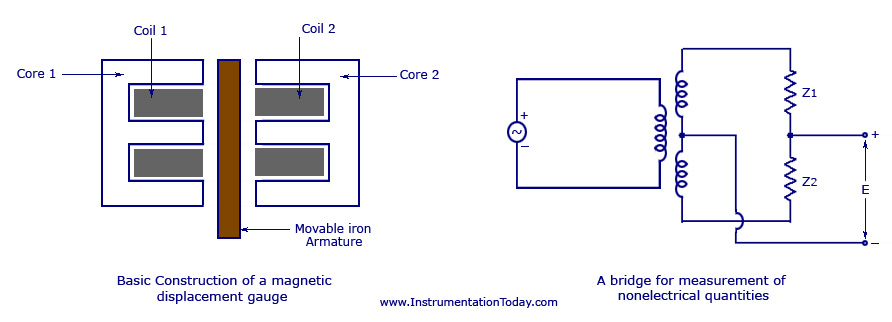
The basic arrangement of a variable inductance strain gauge is shown below. This type of strain gauge is very sensitive and can be used to measure small changes in length – as small as 1 millionth of an inch. Thus, it is highly applicable as a displacement transducer. The member whose strain is to be measured is connected to one end of a moveable iron armature. The long part of the armature is placed between the two cores with wires coiled in between. If the strain produced makes the armature move towards the left core (core 1), it increases the inductance of the left hand coil, that is, coil 1 and decreases the inductance of coil 2. These two coils produce the impedance Z1 and Z2 in the bridge circuit. This produces an output voltage E, which is proportional to the input displacement and hence proportional to the strain. This type of strain gauge is more accurate and sensitive than a resistive strain gauge. But, it is difficult to install the device as it is bulky and complex in construction.

Variable Inductance Type Strain Gauge
                                                   Variable Inductance Type Strain Gauge

Errors in Strain Gauge

Some of the main causes for errors and inaccuracy in the device reading are given below.

  • Temperature Variation – This can be one of the major causes of error in a strain gauge. It can easily change the gauge resistance and cause differential expansion between the gauge and the test piece, causing variation in the measurable strain.
  • Humidity – Humidity can affect the accuracy by the breakdown of insulation between the gauge and the ground point. It also causes electro-chemical corrosion of gauge wire due to electrolysis.
  • Small errors could be caused due to thermoelectric effect.
  • The gauge will be erroneous even due to small factors like zero drift, hysteresis effect and so on.
  • Magnetostrictive effect can also cause errors in strain gauges of ferromagnetic materials. It produces a small voltage fluctuation of almost 2 mill volts.

Strain Gauge Applications

1. Pressure Measurement

2. Acceleration Measurement

3. Temperature Measurement

Accelerometer

in Transducers / No Comments

What is an Accelerometer?

An accelerometer is a transducer that is used to measure the physical or measurable acceleration that is made by an object. Co-ordinate acceleration cannot be measured using this device. (Refer: Acceleration Transducer)

Accelerometer

Accelerometer

An accelerometer is an electro-mechanical device that is used to measure the specific force of an object, a force obtained due to the phenomenon of weight exerted by an object that is kept in the frame of reference of the accelerometer.

In the case of static acceleration, the device is mainly used to find the degrees at which an object is tilted with respect to the ground. In dynamic acceleration, the movement of the object can be foreseen.

Working

The most commonly used device is the piezoelectric accelerometer. As the name suggests, it uses the principle of piezoelectric effect. The device consists of a piezoelectric quartz crystal on which an accelerative force, whose value is to be measured, is applied.

Due to the special self-generating property, the crystal produces a voltage that is proportional to the accelerative force. The working and the basic arrangement is shown in the figure below.

Piezoelectric Accelerometer
                       Piezoelectric Accelerometer

As the device finds its application as a highly accurate vibration measuring device, it is also called a vibrating sensor. Vibration sensors are used for the measurement of vibration in bearings of heavy equipment and pressure lines. The piezoelectric accelerometer can be classified into two. They are high impedance output accelerometer and low impedance accelerometer.

In the case of high impedance device, the output voltage generated in proportion to the acceleration is given as the input to other measuring instruments. The instrumentation process and signal conditioning of the output is considered high and thus a low impedance device cannot be of any use for this application. This device is used at temperatures greater than 120 degree Celsius.

The low impedance accelerometer produces a current due to the output voltage generated and this charge is given to a FET transistor so as to convert the charge into a low impedance output. This type of accelerometers is most commonly used in industrial applications.

Types

In industrial applications, the most commonly used components to convert the mechanical action into its corresponding electrical output signal are piezoelectric, piezoresistive and capacitive in nature. Piezoelectric devices are more preferred in cases where it is to be used in very high temperatures, easy mounting and also high frequency rang e up to 100 kilohertz. Piezoresistive devices are used in sudden and extreme vibrating applications. Capacitive accelerometers are preferred in applications such as a silicon-micro machined sensor material and can operate in frequencies up to 1 kilohertz. All these devices are known to have very high stability and linearity.

Nowadays, a new type of accelerometer called the Micro Electro-Mechanical System (MEMS) Accelerometer is being used as it is simple, reliable and highly cost effective. It consists of a cantilever beam along with a seismic mass which deflects due to an applied acceleration. This deflection is measured using analog or digital techniques and will be a measure of the acceleration applied.

Accelerometer Specifications

  1. Frequency Response – This parameter can be found out by analyzing the properties of the quartz crystal used and also the resonance frequency of the device.
  2. Accelerometer Grounding – Grounding can be in two modes. One is called the Case Grounded Accelerometer which has the low side of the signal connected to their core. This device is susceptible to ground noise. Ground Isolation Accelerometer refers to the electrical device kept away from the case. Such a device is prone to ground produced noise.
  3. Resonant Frequency – It should be noted that the resonant frequency should be always higher the the frequency response.
  4. Temperature of Operation – An accelerometer has a temperature range between -50 degree Celsius to 120 degree Celsius. This range can be obtained only by accurate installment of the device.
  5. Sensitivity – The device must be designed in such a way that it has higher sensitivity. That is, even for a small accelerative force, the electrical output signal should be very high. Thus a high signal can be measured easily and is sure to be accurate.
  6. Axis – Most of the industrial applications requires only a 2-axis accelerometer. But if you want to go for 3D positioning, a 3-axis accelerometer will be needed.
  7. Analog/Digital Output – You must take special care in choosing the type of output for the device. Analog output will be in the form of small changing voltages and digital output will be in PWM mode.

Device Selection

Selection of the device depends on the following factors.

  1. Selection depends on the range of frequency you need.
  2. Depends on the size and shape of the object whose acceleration is to be measured.
  3. Whether the measurement environment is dirty or clean.
  4. Depends on the range of vibration that is to be measured.
  5. Depends on the range of temperature in which the device will have to work.
  6. Depends on whether the device is to be case grounded or grounded isolated.

Applications

  1. Machine monitoring.
  2. Used to measure earthquake activity and aftershocks.
  3. Used in measuring the depth of CPR chest compression.
  4. Used in Internal Navigation System (INS). That is, measuring the position, orientation, and velocity of an object in motion without the use of any external reference.
  5. Used in airbag shooting in cars and vehicle stability control.
  6. Used in video games like PlayStation 3, so as to make the steering more controlled, natural and real.
  7. Used in camcorder to make images stable.