UXDE dot Net Wordpress Themes

Posts Tagged: "Displacement Transducers"

Capacitance Transducer

in Transducers / 1 Comment

Capacitance Transducer

A capacitance pressure transducer is based on the fact that dielectric constants of liquids, solids and gases change under pressure. The figure below shows an arrangement of a cylindrical capacitor that can withstand large pressure. As the change in dielectric constant is quite small (only about ½ percent change for a pressure change of about 10 MPa), it is usable only at large change in pressure. Besides, the capacitance-pressure relation is non-linear and is affected by temperature variation. The measurement of this capacitance is done by a resonance circuit. The schematic is shown below. The oscillogram giving the variation of the output voltage with capacitance is also shown below.

You may also like: Electrical Pressure Transducers and Pressure Transducers

Pressure Measurement by Change in Dielectric Constant Using Resonance Circuit

Capacitive Transducer

A basic capacitive transducer has already been explained (Refer: Capacitive Transducers). It consists of a pair of parallel plates with the middle plate moving with pressure and producing a differential capacitor system. The figure below shows a pressure gauge of this type. Spherical depression of the glass plate is less than 0.0025 centimetres. When a differential pressure exists, the thin steel diaphragm moves towards the low pressure side and the output voltage e0 measured as the difference of voltage e1 and e2 across the two capacitors formed with this movable plate is given by the equation

e0 = e1-e2 = Ex/d

x – Displacement of the diaphragm

d – Diameter

Capacitive Pressure Transducer
                                Capacitive Pressure Transducer

Such transducers are frequently used in pressure transmitter.

Strain Gauge

in Transducers / 5 Comments

Strain Gauge is a passive transducer that converts a mechanical elongation or displacement produced due to a force into its corresponding change in resistance R, inductance L, or capacitance C. A strain gauge is basically used to measure the strain in a work piece. If a metal piece is subjected to a tensile stress, the metal length will increase and thus will increase the electrical resistance of the material. Similarly, if the metal is subjected to compressive stress, the length will decrease, but the breadth will increase. This will also change the electrical resistance of the conductor. If both these stresses are limited within its elastic limit (the maximum limit beyond which the body fails to regain its elasticity), the metal conductor can be used to measure the amount of force given to produce the stress, through its change in resistance.

Strain Gauge Transducer

The device finds its wide application as a strain gauge transducer/sensor as it is very accurate in measuring the change in displacement occurred and converting it into its corresponding value of resistance, inductance or capacitance. It must be noted that the metal conductor which is subjected to an unknown force should be of finite length.

Types

Strain gauge transducers are broadly classified into two. They are

  1. Electrical Resistance Type Strain Gauge

In an electrical resistance strain gauge, the device consists of a thin wire placed on a flexible paper tissue and is attached to a variety of materials to measure the strain of the material. In application, the strain gauge will be attached to a structural member with the help of special cement. The gauge position will be in such a manner that the gauge wires are aligned across the direction of the strain to be measured. The wire used for the purpose will have a diameter between 0.009 to 0.0025 centimeters. When a force is applied on the wire, there occurs a strain (consider tensile, within the elastic limit) that increases the length and decreases its area. Thus, the resistance of the wire changes. This change in resistance is proportional to the strain and is measured using a Wheatstone bridge.

A simple Wheatstone bridge circuit is shown in the figure below. It can be set in three different ways such as – full bridge, half bridge or quarter bridge. A full bridge will have all four of its gauges active. The half bridge will have two of its gauges active and thus uses two precise value resistors. The quarter bridge will have only one gauge and the rest of the resistors will be precise in value.
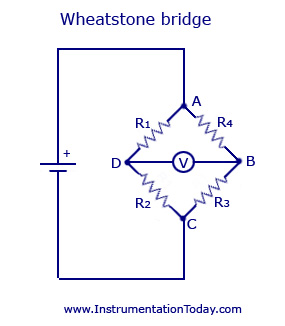
Wheatstone Bridge
                Wheatstone Bridge

A full bridge circuit is used in applications where complimentary pair of strain gauges is to be bounded to the test specimen. In practice, a half bridge and full bridge circuit has more sensitivity than the quarter bridge circuit. But since, the bonding is difficult, a quarter bridge circuits are mostly used for strain gauge measurements. A full bridge circuit is said to be more linear than other circuits.

An external supply is given to the bridge as shown in the diagram. Initially, when there is no application of strain, the output measurement will be zero. Thus, the bridge is said to be balanced. With the application of a stress to the device, the bridge will become unbalanced and produces an output voltage that is proportional to the input stress.

The application of a full bridge and quarter bridge strain gauge circuit is shown in the figure below.
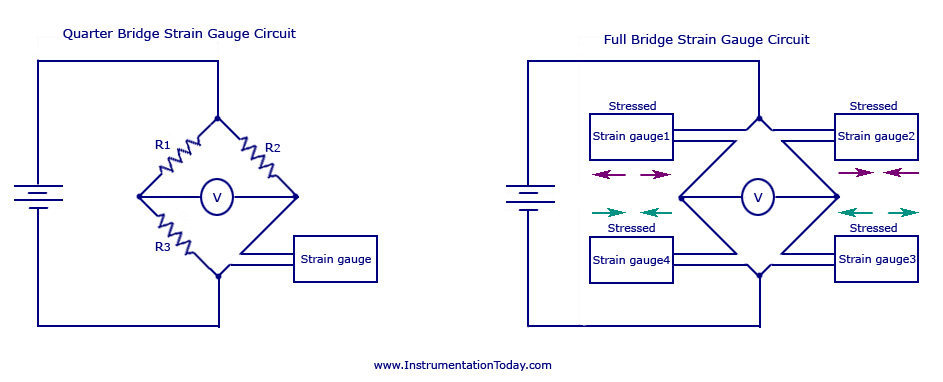
Quarter And Full Bridge Strain Gauge Circuit
                                 Quarter And Full Bridge Strain Gauge Circuit

A quarter bridge output corresponding to the application of a force is shown below. Initially, the circuit will be balanced without the application of any force. When a downward force is applied, the length of the strain gauge increases and thus a change in resistance occurs. Thus an output is produced in the bridge corresponding to the strain.
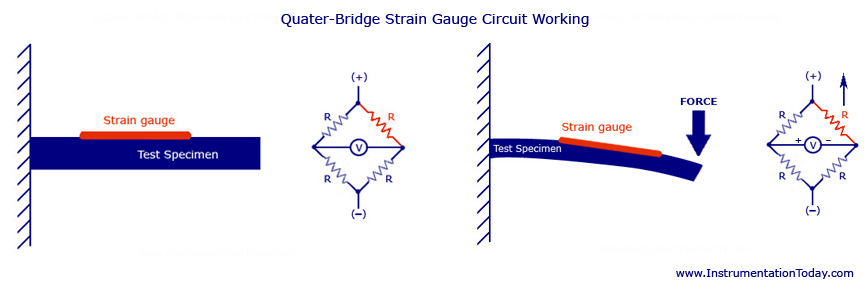
Quarter Bridge Strain Gauge Circuit-Working
                                  Quarter Bridge Strain Gauge Circuit-Working

The wire strain gauge can be further divided into two. They are bonded and unbonded strain gauge.

As shown in the figure below, an unbounded strain gauge has a resistance wire stretched between two frames. The rigid pins of the two frames are insulated. When the wire is stretched due to an applied force, there occurs a relative motion between the two frames and thus a strain is produced, causing a change in resistance value. This change of resistance value will be equal to the strain input.

Unbonded Strain Gauge
                            Unbonded Strain Gauge

A bonded strain gauge will be either a wire type or a foil type as shown in the figure below. It is connected to a paper or a thick plastic film support. The measuring leads are soldered or welded to the gauge wire. The bonded strain gauge with the paper backing is connected to the elastic member whose strain is to be measured.
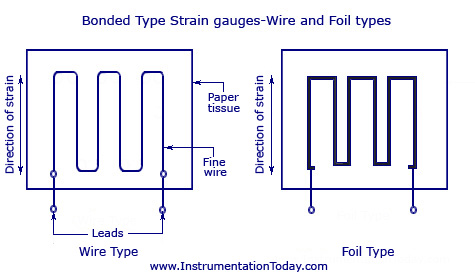
Bonded Type Strain Gauges
                                        Bonded Type Strain Gauges

According to the strain to be measured, the gauges can be classified as the following.

  • Uniaxial/Wire Strain Gauge

The figure of such a strain gauge is shown above. It mostly uses long and narrow sensing elements so as to maximize the length of the strain sensing material in the desired direction. Gauge length is chosen according to the strain to be calculated.

Gauge Configurations

Gauge Configurations

  • Biaxial Strain Gauges

When the measurement of strain is to be done in two directions (mostly at right angles), this method is used. The basic structure for this is the two element 90 planar rosette or the 90 planar shear/stacked foil rosette. The gauges are wired in a Wheatstone bridge circuit to provide maximum output. For stress analysis, the axial and transfers elements have different resistances which can be selected that the combined output is proportional to the stress while the output of the axial element alone is proportional to the strain. The figure is given below.

  • Three Element Rosettes

It is divided into two types – three element 60delta rosette strain gauge and three element 45planar rectangular rosette. They are used in applications where both the magnitude and direction of the applied strains are to be found out. Both the figures are shown below. The 60 rosette is used when the direction of the principal strain is unknown. The 45 rosette is used to determine a high angular resolution, and when the principal strains are known.

    2.   Semiconductor Strain Gauge

This is the most commonly used strain gauge as a sensor, although the bonded type may also be used in stress analysis purposes. The bonded type is usually made in wafers of about 0.02 centimeters in thickness with length and resistance values nearly equal to the wire gauge. It uses either germanium or silicon base materials to be made available in both n-type or p-type. The p-type gauges have a positive gauge factor while the n-type gauges have a negative gauge factor. Temperature dependence of gauge factor is governed by the resistivity of the material. The large value of the gauge factor in semiconductor gauges is attributed to the piezoresistance effect in such materials.

Variable Inductance Type Strain Gauge

The basic arrangement of a variable inductance strain gauge is shown below. This type of strain gauge is very sensitive and can be used to measure small changes in length – as small as 1 millionth of an inch. Thus, it is highly applicable as a displacement transducer. The member whose strain is to be measured is connected to one end of a moveable iron armature. The long part of the armature is placed between the two cores with wires coiled in between. If the strain produced makes the armature move towards the left core (core 1), it increases the inductance of the left hand coil, that is, coil 1 and decreases the inductance of coil 2. These two coils produce the impedance Z1 and Z2 in the bridge circuit. This produces an output voltage E, which is proportional to the input displacement and hence proportional to the strain. This type of strain gauge is more accurate and sensitive than a resistive strain gauge. But, it is difficult to install the device as it is bulky and complex in construction.
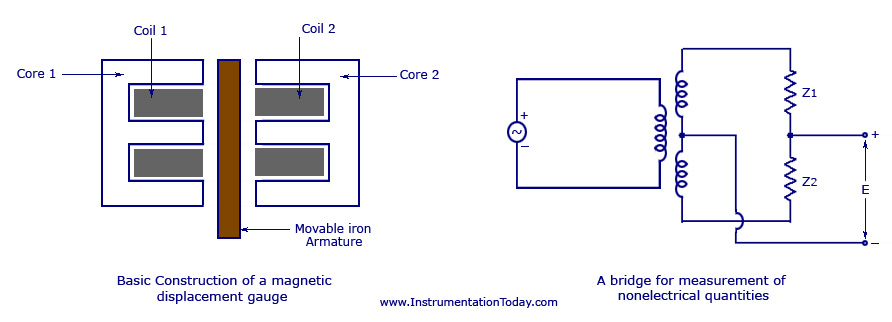
Variable Inductance Type Strain Gauge
                                                   Variable Inductance Type Strain Gauge

Errors in Strain Gauge

Some of the main causes for errors and inaccuracy in the device reading are given below.

  • Temperature Variation – This can be one of the major causes of error in a strain gauge. It can easily change the gauge resistance and cause differential expansion between the gauge and the test piece, causing variation in the measurable strain.
  • Humidity – Humidity can affect the accuracy by the breakdown of insulation between the gauge and the ground point. It also causes electro-chemical corrosion of gauge wire due to electrolysis.
  • Small errors could be caused due to thermoelectric effect.
  • The gauge will be erroneous even due to small factors like zero drift, hysteresis effect and so on.
  • Magnetostrictive effect can also cause errors in strain gauges of ferromagnetic materials. It produces a small voltage fluctuation of almost 2 mill volts.

Strain Gauge Applications

1. Pressure Measurement

2. Acceleration Measurement

3. Temperature Measurement

Displacement Transducers

in Transducers / No Comments

Displacement is a basic variable whose value is measured and involved in many other physical parameters such as velocity, force, acceleration, torque and so on. The transducer used for the measurement of displacement can be classified in many ways. One of the most common classification is given below.

  • Mechanical
  • Pneumatic
  • Electrical
  • Optical

In order to obtain an electrical output, a mixture of two or more methods is also used. For example, optical methods using photo-detectors present the output as an electrical quantity like voltage, current and so on. Thus, the combined mechanical and optical method is desired.

Measurements can be made in the direct and indirect way. In direct method, the displacement is measured directly. But indirect methods are mostly used as the associated variables like force, acceleration, torque, velocity and so on can be obtained.

In electrical conversion method, the displacement is converted to an electrical quantity like voltage or current. This value is then recorded or displayed on a screen.

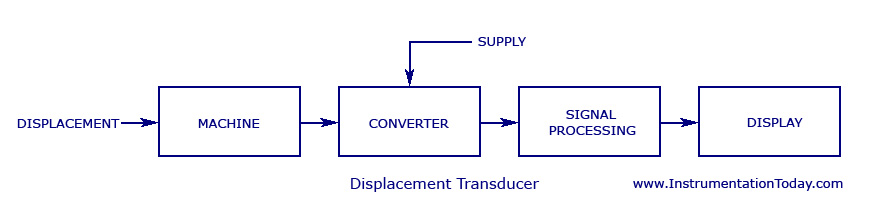
A basic displacement scheme is shown in the figure below.

Displacement Transducer
                                                      Displacement Transducer

Some of the most commonly used methods are listed and explained below. Though some of these methods can be used for the measurement of other physical quantities, the electrical signals derived from such transducers always depend on a displacement parameter.

Photo-Electric Transducers

Before explaining about the different photo-electric transducers, it is important to know the basics of photo-electric effect.
Photo-Electric Effect – It can be explained as the electric current produced when a light of certain intensity strikes on a piece of metal. The energy contained in the light is transferred to the surface of the metal and thus produce a movement of electrons. This movement produces a current. This effect cannot be produced by all colors in the spectrum. A
bright red colored light will not produce a current flow in the metal. But, a dim blue light can cause current flow. Thus, the only way to decide the colors producing the photo-electric effect is through the concept of photons. The idea was brought forward by Albert Einstein, and according to him, light is made up of small packets of energy that had the behavior of particles. These packets of energy were named photons. A red light does not move the electrons, as their individual photons does not have much energy. But a blue light can move electrons as their individual photons have more energy than that of red light. The electrons thus emitted in this manner are called photo electrons.

Some of the most commonly used displacement transducers through the application of photo-electric effect are explained below.

1. Vacuum Photo-Tube as Transducer

A schematic of the vacuum photo-tube transducer is shown in the figure below.

Vaccum Photo-Tube Transducer
                        Vaccum Photo-Tube Transducer

A displacement produced will modulate or change the intensity of the light intensity of the light incident on the photo-cathode. This changes the amount of voltage and thus, the proportional anode current is given to the resistor R. This changes the output voltage. The output voltage produced will be proportional to the amount of displacement given as input. This transducer is appropriate when there is an availability of a stable light source or an ac modulated light.

Advantages

  • Efficiency is fairly high.
  • Can take both static and dynamic measurements.

Disadvantages

  • Stability is achieved only for a short period.
  • If the light variations are subjected to high temperatures, there will be very little response.
  • Only suitable for applications having large displacements.

2. Photo-Diode as Transducer

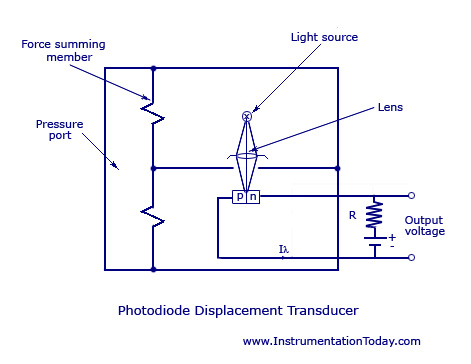
The circuit for a photo-diode transducer is shown below.

Photo-Diode  Transducer
                                          Photo-Diode Transducer

The arrangement is almost same as a photo-tube transducer except that the photo-tube has been replaced by a photo-diode and the lens has been replaced to make the light strike on the junction of the photo-diode. When a displacement is produced, it provides a force on the summing member and thus changes the quantum of light intensity incident on the photo-diode junction. The proportional change in anode voltage produces a current in the resistor R. Thus, an output voltage is produced which will be proportional to the displacement given as input.

3. Photo-Conductor as Transducer

The circuit is the same as a vacuum photo-tube arrangement except that the photo-conductor is placed instead of a photo-tube. The displacement causes a unique light intensity incident on the photo-conductor and causes a variation in current through resistor R. Hence the output voltage produced will be a linear function of the displacement produced. This device is not used much as the sensitivity produced remains stable only at the beginning and becomes poor at high frequencies.

4. Photo-Voltage Cell as Transducer

This device has great applications in electronic instrumentation and control circuits as it is an active transducer and needs no associated energy source. According to the light intensity striking on the photo-voltage cell, it illuminates and produces a small proportional voltage. The circuit diagram is the same as that given above except that the photo-tube is replaced by photo-voltaic cell and the source for voltage is taken away. The working is also the same as that explained above and it can be calibrated according to the amount of displacement produced.

Capacitive Transducers

in Transducers / 10 Comments

To learn about a capacitive transducer, it is important to know the basics of a parallel plate capacitor. Being the simplest form of a capacitor, it has two parallel conducting plates that are separated to each other by a dielectric or insulator with a permittivity of Ε (for air). Other than paper, vacuum, and semi-conductor depletion region, the most commonly used dielectric is air.

Due to a potential difference across the conductors, an electric field develops across the insulator. This causes the positive charges to accumulate on one plate and the negative charges to accumulate on the other. The capacitor value is usually denoted by its capacitance, which is measured in Farads. It can be defined as the ratio of the electric charge on each conductor to the voltage difference between them.

The capacitance is denoted by C. In a parallel plate capacitor, C = [A*Er*9.85*1012 F/M]/d

A – Area of each plate (m)

d – Distance between both the plates (m)

Er – Relative Dielectric Constant

The value 9.85*1012 F/M is a constant denoted by Eo and is called the dielectric constant of free space.
From the equation it is clear that the value of capacitance C and the distance between the parallel plates,d are inversely proportional to each other. An increase of distance between the parallel plates will decrease the capacitance value correspondingly. The same theory is used in a capacitive transducer. This transducer is used to convert the value of displacement or change in pressure in terms of frequency.

You may also like: Capacitance Transducer

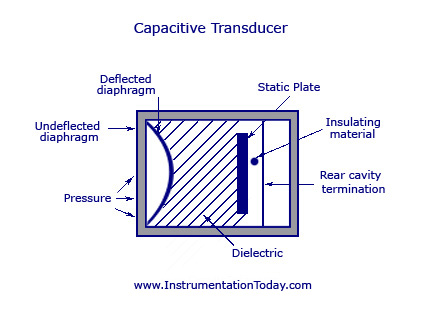
As shown in the figure below, a capacitive transducer has a static plate and a deflected flexible diaphragm with a dielectric in between. When a force is exerted to the outer side of the diaphragm the distance between the diaphragm and the static plate changes. This produces a capacitance which is measured using an alternating current bridge or a tank circuit.

Capacitive Transducer
                                 Capacitive Transducer

A tank circuit is more preferred because it produces a change in frequency according to the change in capacitance. This value of frequency will be corresponding to the displacement or force given to the input.

Advantages

  • It produces an accurate frequency response to both static and dynamic measurements.

Disadvantages

  • An increase or decrease in temperature to a high level will change the accuracy of the device.
  • As the lead is lengthy it can cause errors or distortion in signals.

Linear Voltage Differential Transformer (LVDT)

in Transducers / 1 Comment

Like other inductive transducers, this transducer is also used for converting a linear motion into an electrical signal. The basic construction of an LVDT is explained and shown in the figure below.

Construction

LVDT Construction
                                                       LVDT Construction

The device consists of a primary winding (P) and two secondary windings named S1 and S2. Both of them are wound on one cylindrical former, side by side, and they have equal number of turns. Their arrangement is such that they maintain symmetry with either side of the primary winding (P). A movable soft iron core is placed parallel to the axis of the cylindrical former. An arm is connected to the other end of the soft iron core and it moves according to the displacement produced.

Working

As shown in the figure above, an ac voltage with a frequency between (50-400) Hz is supplied to the primary winding. Thus, two voltages VS1 and VS2 are obtained at the two secondary windings S1 and S2 respectively. The output voltage will be the difference between the two voltages (VS1-VS2) as they are combined in series. Let us consider three different positions of the soft iron core inside the former.

  • Null Position – This is also called the central position as the soft iron core will remain in the exact center of the former. Thus the linking magnetic flux produced in the two secondary windings will be equal. The voltage induced because of them will also be equal. Thus the resulting voltage VS1-VS2 = 0.
  • Right of Null Position – In this position, the linking flux at the winding S2 has a value more than the linking flux at the winding S1. Thus, the resulting voltage VS1-VS2 will be in phase with VS2.
  • Left of Null Position – In this position, the linking flux at the winding S2 has a value less than the linking flux at the winding S1. Thus, the resulting voltage VS1-VS2 will be in phase with VS1.

From the working it is clear that the difference in voltage, VS1-VS2 will depend on the right or left shift of the core from the null position. Also, the resulting voltage is in phase with the primary winding voltage for the change of the arm in one direction, and is 180 degrees out of phase for the change of the arm position in the other direction.

The magnitude and displacement can be easily calculated or plotted by calculating the magnitude and phase of the resulting voltage.

Difference output Voltage Vs Displacement Curve

The graph above shows the plot between the resulting voltage or voltage difference and displacement. The graph clearly shows that a linear function is obtained between the output voltage and core movement from the null position within a limited range of 4 millimeter.

The displacement can be calculated from the magnitude of the output voltage. The output voltage is also displayed on a CRO or stored in a recorder.

Advantages

1. Maintains a linear relationship between the voltage difference output and displacement from each position of the core for a displacement of about 4 millimeter.

2. Produces a high resolution of more than 10 millimeter.

3.Produces a high sensitivity of more than 40 volts/millimeter.

4. Small in size and weighs less. It is rugged in design and can also be assigned easily.

5. Produces low hysteresis and thus has easy repeatability.

Disadvantages

1. The whole circuit is to be shielded as the accuracy can be affetced by external magnetic field.

2. The displacement may produce vibrations which may affect the performance of the device.

3. Produces output with less power.

4. The efficiency of the device is easily affected by temperature. An increase in temperature causes a phase shift. This can be decreased to a certain extent by placing a capacitor across either one of the secondary windings.

5. A demodulator will be needed to obtain a d.c output.

Proximity Inductive Transducers

in Transducers / 1 Comment

This type of transducer is used for finding the linear displacement in terms of voltage or other digital parameters. Another transducer for finding the linear displacement is the Linear Motion Variable Inductance Transducer.

There are mainly two types of proximity inductance transducers. They are

Mutual Inductance Type Proximity Transducer

This transducer consists of a primary and secondary coil. The constructional diagram of the transducer is shown below.

Proximity Inductive Transducers

Proximity Inductive Transducers

Working

An ac source is given to the primary. This ac source excites the primary and a flux is produced. This flux is linked to the secondary coil and thus a voltage ‘V’ is induced. If the mutual inductance between the primary and secondary windings is represented by ‘M’ (Hertz) and the frequency of ac excitation is represented by ‘w’, then the voltage ‘V’ developed in secondary coil can be written as V = MwIp.
Ip – The current due to excitation in primary (Amperes).

As shown in the figure, a ferromagnetic displacement plate is placed very near to the windings. The current in the primary coil produces a magnetic flux that links with the secondary coil through the displacement plate. Thus, the movement of the ferromagnetic plate to the right causes a greater value of flux linkage between the two terminals. This in turn causes an increase in the resulting output voltage across the secondary terminal with a value of (T1-T2). This output is given to the input of the CRO or a recorder and the amount of displacement can be known in terms of voltage. A

Advantages

1. The device is small when compared to other transducers.

2. Wear and tear is minimized as there is no physical contact between the target and coil configuration.

3. The output value will be accurate for small displacements as there is a linear relation between the output voltage and linear displacement.

4. There will not be any external effects by contamination.

5. The device works accurately even at higher temperatures up to 400 degree Celsius.

Disadvantages

1. The accuracy decreases when it comes to the measure of large displacement. This is because the linear relation between voltage and displacement is less at higher ranges.

2. The external magnetic field may cause harm to the ferromagnetic material.

Variable Reluctance Type Proximity Transducers

This device can be set up in two ways. Both the diagrams are shown below.

Variable Reluctance Type Proximity Transducers

Variable Reluctance Type Proximity Transducers

Working

The device consists of a coil that is wound on a core made up of ferromagnetic material. The displacement is given to the core through a target that makes an upward and downward movement according to the displacement produced. It does not touch the core of the coil and a smaller air gap is made between them.
When the target moves closer to the coil due to the displacement, the air gap becomes less causing the reluctance of the magnetic field to reduce and thus the coil inductance to increase. The value of inductance keeps on varying according to the variation in target movement. A CRO or a recorder takes these values and displays it to the user.

In the right side figure shown above, an E-type core is used for finding the displacement. The target is also pivoted at the central limb of the core. Thus, a single coil is divided into two turns and the end of each coil works as the arms of an inductance bridge.

As the displacement value changes, an output signal is produced. This is given to a CRO after amplification.

The biggest advantage of this device is that it shows a linear relationship between the output and the displacement.


Linear Potentiometer Transducer

in Transducers / No Comments

A linear potentiometer transducer consists of a potentiometer, which is short circuited by a slider. The other end of the slider is connected to a slider arm. The force summing device on the slider arm causes linear displacement of the slider causing the short circuit of a certain portion of the resistance in the potentiometer. Let the whole resistance positions on the potentiometer be ABC. Let the resistance position caused by the slider movement be BC. As the movement of the slider moves further to the right, the amount of resistance increases. This increase in resistance value can be noted according to the corresponding change in the linear displacement of the slider. The change in resistance can be calculated with the help of a Wheatstone bridge.

Another easy method than calculating the resistance with the help of a bridge connection is to connect a constant current source in series with the potentiometer. Thus a voltage will be developed. This voltage can be measured and hence the resistance, R = V/I.

Linear Potentiometer Transducer

Some of the most commonly used potentiometers for this purpose and their basic working is explained below.

1. Wire-Wound Potentiometer – The most commonly used resistance elements in this potentiometer are nickel, chromium or nickel copper. As these materials have a very low temperature coefficient of resistance, they can be used to handle large currents and also can be used up to 5 Hertz. They are also very cost effective. The winding of the resistance wire will depend on the different types of resistance changes due to the slider motion like linear, arithmetic, logarithmic and so on.

2. Cermet Potentiometer – This potentiometer is made from a material called Cermet which is made by mixing a paste of precious metal particles and a ceramic. Some of the most common mixtures used are palladium silver glass and palladium oxide glass. This device is used mostly for ac purposes as it has a low temperature coefficient of resistance and huge power ratings at high temperatures. Out of the lot, this device is mostly used as it is cost-effective.

3. Hot-Moulded Carbon Potentiometers – As the name implies, it is made by depositing a thin film of carbon and a thermosetting plastic binder. This device is mostly used for alternating current (ac) purposes.

4. Carbon Film Potentiometers – This potentiometer is made by coating a thin layer of carbon film on a non-conductive base. The temperature coefficient of resistance of this device is 1000 x 10-6 ohms/degree Celsius.

5. Thin Metal Film Potentiometer – This device is in the form of a thin vapour deposited layer of metal on glass or ceramic base. This is also used for ac applications.

Advantages

  • Cost-effective
  • Simple design and simple working
  • Can be used for measuring even large displacements.
  • The device produces a large output and hence can be used for control purposes without further amplification steps. Thus the whole operation is bounded to a single device.
  • Can produce a high electrical efficiency.
  • All devices other than wire-wound potentiometer can be used for a large frequency range.
  • Except wire wound, all other potentiometers can provide excellent resolutions.

Disadvantages

  • A huge force may be required for the slider movement.
  • Can produce unwanted noise due to alignment problems, wear and tear of the sliding contact. This may also affect the total life of the device.